 By admin
When Headlines Become Market Movers
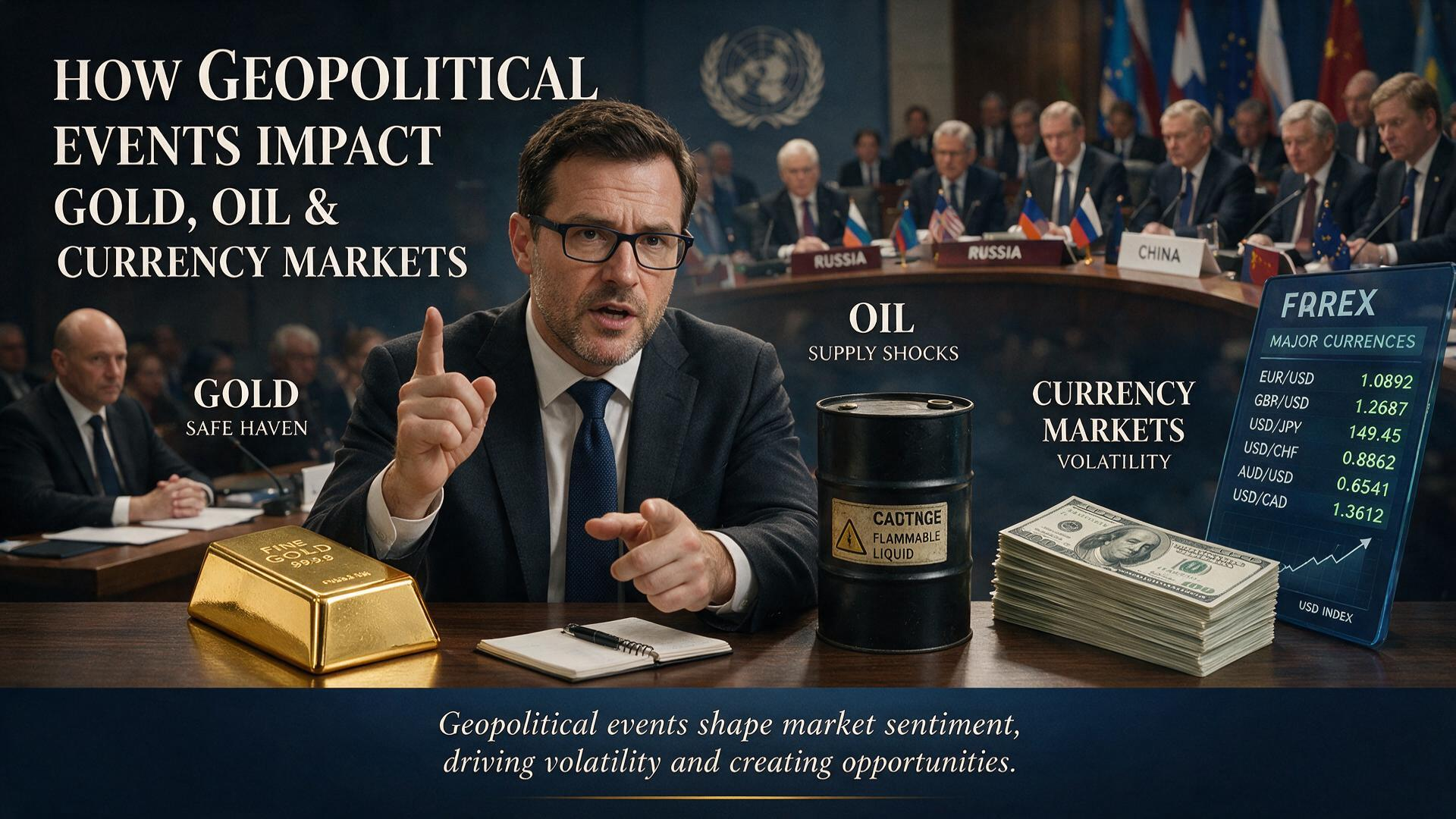
Most of the time, markets are driven by the slow grind of earnings, interest rates, and economic data. Then a missile launches, a border is crossed, or a major exporter gets sanctioned, and everything changes in an instant. Gold spikes, oil surges, and currencies swing wildly as traders scramble to reprice risk. These aren't rare events—they happen constantly, and ignoring them is not an option for anyone with meaningful exposure to commodities or currencies. Understanding geopolitical market risks is about recognizing which events matter, how they transmit to prices, and what you can realistically do about them.
The first thing to understand is that markets don't react to events—they react to the implications of events. A military conflict in a region that produces a lot of oil is a bigger deal for oil prices than a conflict in a region that doesn't. A sanction on a major commodity exporter is a bigger deal than a sanction on a country with a small share of global trade. The market is constantly asking: does this event change the supply and demand balance for anything I care about? If the answer is yes, prices move. If the answer is no, the reaction is usually brief.
It's also worth understanding that geopolitical events are unpredictable in both timing and outcome. Nobody knows when the next crisis will hit or how it will resolve. That unpredictability makes geopolitical risk different from the kinds of risks that can be modeled statistically. You can't diversify away the risk of a war breaking out. You can't hedge against every possible geopolitical scenario. What you can do is build a portfolio that's resilient to a range of outcomes, and understand how different assets are likely to behave when things go wrong. The currency market analysis that ignores geopolitics is incomplete, because currencies are often the first place risk shows up.
Gold: The Crisis Asset That Doesn't Always Work
Gold has a reputation as the ultimate safe-haven asset, and there's a good reason for that reputation. Throughout history, gold has held its value during wars, revolutions, currency collapses, and financial crises. It's not anyone's liability, it can't be printed, and it doesn't depend on a government's creditworthiness. When investors are scared, they tend to buy gold, and that buying pressure pushes prices up. That's the pattern that's made gold a staple of crisis portfolios for centuries.
But the relationship between gold price movements and geopolitical events is more complicated than the safe-haven narrative suggests. Gold doesn't always rise during crises. In March 2020, as the COVID pandemic sent markets into freefall, gold fell initially as investors sold profitable assets to cover margin calls elsewhere. It recovered quickly, but the initial drop surprised people who expected gold to be immune to the panic. That episode illustrated an important point: in a liquidity crisis, correlations can go to one, and even safe-haven assets can be sold if investors need cash.
The intensity and nature of the event matter. A geopolitical event that threatens the global financial system, like a major war or a sovereign default, tends to be strongly positive for gold. A regional conflict that doesn't threaten broader stability may produce only a modest and temporary bump. Gold also responds to the response to the event. If a conflict leads to sanctions that reduce central bank holdings of dollar reserves, gold may benefit as central banks diversify. If it leads to a flight to the dollar, gold may struggle because the dollar's strength makes gold more expensive for foreign buyers.
Central bank buying has added a structural layer to gold's relationship with geopolitics. In recent years, central banks have been buying gold at record rates, partly to diversify away from dollar reserves and partly to protect against the risk of sanctions. That buying isn't driven by short-term crises—it's a strategic shift that reflects a more fragmented geopolitical landscape. The result is that gold has a persistent bid that didn't exist a decade ago, which has changed how it responds to geopolitical events. It's less of a pure fear trade now and more of a structural allocation, which makes its behavior somewhat more stable.
Oil: The Most Direct Geopolitical Market
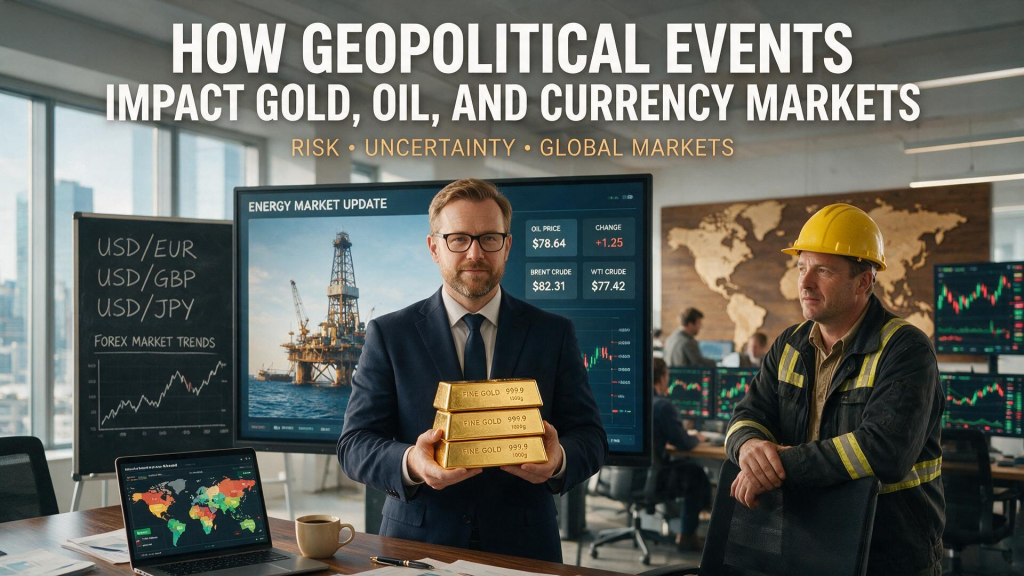
Oil is the commodity most directly affected by geopolitics, because so much of the world's oil comes from regions that are prone to conflict. The Middle East, in particular, is home to some of the largest oil reserves on the planet, and any disruption there sends ripples through global markets. A conflict that threatens oil infrastructure, shipping routes, or production capacity can move prices dramatically, because there's no easy substitute for oil in the short term. The world needs it, and if the supply is threatened, buyers will pay whatever it takes to get it.
The oil market volatility that follows a geopolitical event is often extreme. Prices can spike 10% or more in a single day, and they can fall just as quickly if the disruption turns out to be temporary. That volatility is a challenge for investors, because it means the timing of geopolitical events matters as much as the events themselves. Buying oil after a spike often means buying at the top, and selling after a drop often means selling at the bottom. The investors who do best are the ones who understand the difference between a temporary disruption and a permanent shift in supply.
The nature of the event matters. A conflict that disrupts production for a few weeks is different from one that destroys infrastructure and takes years to rebuild. A sanction that reduces a country's exports is different from a blockade that cuts off a region entirely. The market prices in expectations about duration and severity, and those expectations can change as the event unfolds. That's why oil prices often fall after an initial spike—the market realizes that the disruption isn't as bad as it feared, or that other producers can fill the gap. The initial move is often driven by fear, and the subsequent move is driven by reality.
It's also worth understanding that oil's geopolitical risk is asymmetric. Prices are much more sensitive to supply disruptions than to demand shocks, because supply can be cut off quickly while demand takes time to adjust. A conflict that threatens production can send prices soaring, even if the actual disruption is small. A conflict that reduces demand, like a war that slows economic activity, tends to push prices down. That asymmetry is why oil is often described as a geopolitical commodity—its price is disproportionately affected by events that threaten supply.
Currencies: Where Risk Shows Up First
Currency markets are often the first place geopolitical risk is priced, because currencies are the most liquid and easily traded assets in the world. When a crisis hits, money moves quickly, and the direction it moves tells you a lot about how the market is interpreting the event. Traditional safe-haven currencies like the U.S. dollar, the Swiss franc, and the Japanese yen tend to strengthen during crises, while currencies of countries directly affected by the event tend to weaken. The currency market analysis that tracks these flows can provide early signals about how the market is pricing risk.
The dollar's role is particularly important. As the world's reserve currency, the dollar is the default destination for capital during crises, because it's the most liquid and widely accepted currency in the world. When a geopolitical event occurs, investors often buy dollars, which strengthens the currency. That flight to safety can be powerful, and it can override other factors that might normally affect the dollar. A crisis can push the dollar higher even if the U.S. economy is weakening, because the demand for safety overwhelms the fundamentals.
Commodity currencies—the currencies of countries that export a lot of natural resources—often move in response to geopolitical events that affect commodity prices. The Canadian dollar tends to rise when oil prices rise, because Canada is a major oil exporter. The Australian dollar tends to rise when commodity prices rise more broadly. The global commodity trends and currency movements are linked, and understanding that link can help you anticipate how currencies will react to geopolitical events. If a conflict pushes oil prices higher, the Canadian dollar may strengthen even if Canada isn't directly involved.
Emerging market currencies are often the most vulnerable to geopolitical risk. They're less liquid than major currencies, and they're more sensitive to shifts in risk appetite. When investors get nervous, they tend to pull money out of emerging markets and move it to safer assets, which weakens emerging market currencies. That dynamic can create a vicious cycle, because a weakening currency can trigger more outflows, which weakens the currency further. The currency crises that hit countries like Turkey and Argentina are examples of how geopolitical and economic stress can combine to produce dramatic currency moves.
Building a Portfolio That Can Handle Geopolitical Shocks
The first step in managing geopolitical risk is to accept that you can't predict it. Nobody knows when the next crisis will hit or what form it will take. That means you can't position your portfolio for specific events. What you can do is build a portfolio that's diversified across assets that respond differently to geopolitical stress. Gold, oil, and currencies all have their own relationships with risk, and owning a mix gives you exposure to different outcomes without betting everything on one scenario.
Diversification across geographies also matters. A conflict in one region may have little effect on markets in another, and a portfolio that's concentrated in a single country or region is more vulnerable to local shocks. Spreading your investments across different economies reduces the risk that a single geopolitical event will derail your portfolio. That's true for stocks, bonds, and currencies, and it's one of the most reliable ways to manage geopolitical risk.
Position sizing is another key defense. Geopolitical events can produce sharp moves, and positions that are too large can suffer disproportionate losses. Keeping individual positions modest, and keeping your overall exposure to any single theme or region limited, reduces the damage that a surprise event can do. That doesn't mean you should avoid risk entirely—it means you should size your positions so that a shock doesn't force you to sell at the worst possible time. The oil market volatility that follows a conflict is a reminder that markets can move faster than you expect, and positions that were comfortable before can become unbearable after.
Finally, have a plan for what you'll do when a geopolitical shock hits. Decide in advance whether you'll sell, hold, or buy more, and under what conditions. Having that plan written down before the event makes it easier to follow when emotions are running high. It also helps to remember that geopolitical shocks are usually temporary in market terms. The initial reaction is often violent, but markets tend to adapt and recover. The investors who do best are the ones who stay calm, stick to their plan, and don't let the headlines drive their decisions. That's easier said than done, but it's the difference between a portfolio that survives geopolitical shocks and one that gets blown apart by them.