 By admin
The Problem With Having Accounts Everywhere
It happens to almost every investor eventually. You open a 401(k) at your first job. You leave that job and roll the balance into an IRA. You open a brokerage account to buy a few stocks. Your spouse has an account too. Maybe there's a 529 for the kids, a Roth IRA you contribute to when you can, and a handful of old accounts from employers you've long since moved on from. Each one makes sense on its own. Together, they're a mess. You have no idea what your actual asset allocation is, whether you're properly diversified, or how your portfolio is really performing. That's the problem an investment portfolio tracker solves, and it's a bigger problem than most people realize.
The fragmentation isn't just inconvenient—it's dangerous. Without a consolidated view, you can't see that you're actually 45% concentrated in technology stocks across all your accounts combined. You can't see that the international fund in your 401(k) overlaps heavily with the international ETF in your brokerage account. You can't see that your bond allocation has drifted far from your target because one account has grown faster than the others. The asset allocation monitoring that a good tracker provides is what turns a collection of accounts into a coherent portfolio.
The other issue is performance measurement. If you have five accounts, each with its own returns, you don't know your overall return. You don't know whether your decisions are adding value or subtracting it. You don't know whether you're on track to meet your goals. The investment performance tracking that a tracker provides gives you the consolidated view you need to answer those questions, and without it, you're flying blind on the most important metric of all.
What a Good Tracker Actually Does
A portfolio tracker aggregates your accounts into a single view. That sounds simple, but the execution matters. A good tracker connects to your brokerage accounts, retirement accounts, and bank accounts, either through direct integrations or through manual entry. It pulls in your holdings, your transactions, and your balances, and it presents them in a way that lets you see the whole picture. The portfolio management tools that work are the ones that make this aggregation easy enough that you'll actually keep it up to date.
The core feature of any tracker is the holdings view. It shows you every position you own, across every account, in a single list. That lets you see your total exposure to any given stock, sector, or region, which is essential for understanding your actual diversification. Without that view, you're guessing at your allocation, and guessing is not a strategy. The investment portfolio tracker that shows you the consolidated holdings is the foundation for everything else.
Performance tracking is the next essential feature. A good tracker shows you your returns over different time periods—one month, one year, three years, five years—and compares them to relevant benchmarks. It also shows you your returns on a money-weighted and time-weighted basis, so you can see whether your contributions and withdrawals are helping or hurting. That's more sophisticated than most people need on a day-to-day basis, but it's valuable for understanding whether your strategy is working. The portfolio analysis software that provides this level of detail is more useful than one that just shows you a total balance.
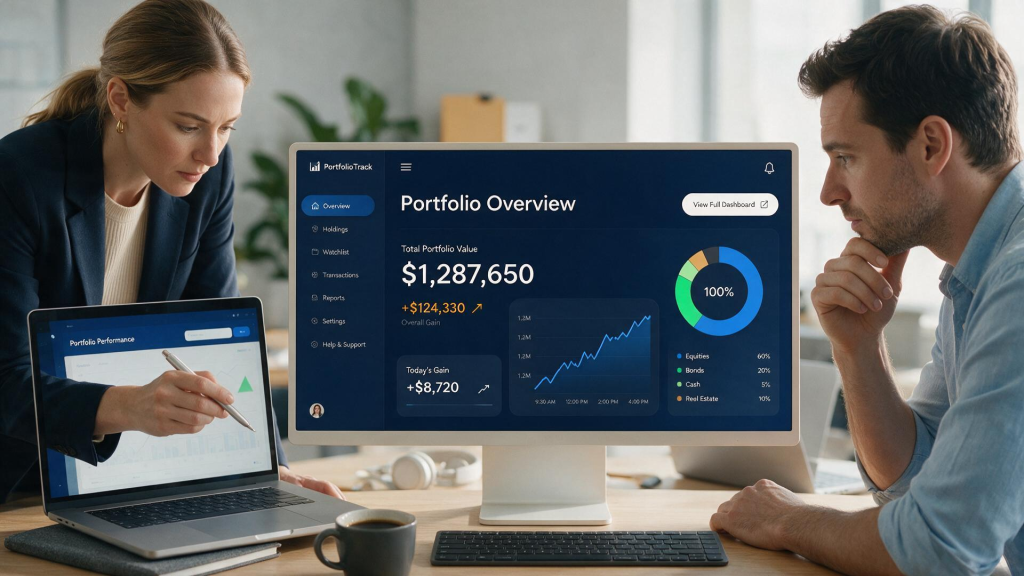
Allocation analysis is the third key feature. A good tracker shows you your asset allocation across stocks, bonds, cash, and other categories, and breaks down your stock allocation by sector, region, and market cap. That lets you see whether your portfolio is as diversified as you intended, or whether it's drifted toward concentration. The asset allocation monitoring that a tracker provides is one of the most valuable things it does, because it catches problems that are invisible when you look at accounts individually.
Manual Entry vs. Automatic Aggregation
The biggest decision when choosing a tracker is whether to use one that connects automatically to your accounts or one that requires manual entry. Automatic aggregation is convenient—you link your accounts once, and the tracker keeps them updated. It's also more accurate, because it captures every transaction without you having to remember to enter it. The portfolio management tools that connect to major brokerages make this easy, and the best ones handle a wide range of account types.
But automatic aggregation comes with security considerations. You're giving a third-party app access to your financial accounts, which is a real risk if the app isn't secure. Most reputable trackers use encryption and don't store your login credentials, but the risk isn't zero. If you're uncomfortable with that, manual entry is a viable alternative. It's more work, but it gives you full control over your data. The investment portfolio tracker that works for you is the one that matches your comfort level with technology and security.
Manual entry has another advantage: it forces you to engage with your portfolio regularly. If you have to enter your holdings every month, you'll notice changes and trends that you might miss if everything were automated. That engagement can be valuable, especially for investors who want to be more hands-on. The portfolio analysis software that requires manual entry is more work, but it can be more educational.
A hybrid approach is also possible. Some trackers let you connect some accounts automatically while entering others manually, which gives you flexibility. That's useful if you have a mix of accounts at major brokerages and smaller institutions that don't support automatic connections. The investment performance tracking that works is the tracking that actually gets done, and a hybrid approach can make it easier to maintain.
Making Sense of the Data
Once you have all your accounts in one place, the challenge is making sense of the data. A tracker can show you a lot of numbers, but numbers without context are just noise. The key is to focus on the metrics that matter for your goals, and to ignore the ones that don't. For most long-term investors, that means focusing on asset allocation, total return, and progress toward goals, rather than on daily price movements or short-term performance.
Asset allocation is the most important metric for long-term investors, because it drives both risk and return. A tracker that shows you your allocation across stocks, bonds, and cash, and breaks down your stock allocation by sector and region, gives you the information you need to decide whether your portfolio is positioned appropriately. The asset allocation monitoring that a tracker provides is the foundation for rebalancing, which is one of the most important disciplines for long-term investors.
Total return is the next key metric. It combines price appreciation and income, and it's the measure that matters for long-term wealth building. A tracker that shows you your total return over multiple time periods, and compares it to relevant benchmarks, gives you a sense of whether your strategy is working. The investment performance tracking that includes total return is more useful than one that only shows price changes, because it captures the full picture of your returns.
Progress toward goals is the third key metric. A good tracker lets you set goals—retirement, a house, a child's education—and track your progress toward them. That's more motivating than just watching a balance grow, because it connects your investments to the things you actually care about. The portfolio analysis software that includes goal tracking is more useful than one that only shows you numbers, because it gives those numbers meaning.
Keeping the Tracker Useful Over Time
A tracker is only useful if it's up to date. That means reviewing it regularly, updating any manual entries, and checking that the automatic connections are still working. A tracker that's out of date is worse than no tracker at all, because it gives you a false sense of confidence. The portfolio management tools that work are the ones that fit into a regular routine, whether that's a monthly review or a quarterly check-in.
It's also worth using the tracker to guide decisions, not just to observe. If the tracker shows that your allocation has drifted, use that as a signal to rebalance. If it shows that a particular holding has grown too large, use that as a signal to trim. If it shows that your returns are lagging a benchmark, use that as a signal to investigate why. The investment portfolio tracker that informs your decisions is more valuable than one that just sits there displaying numbers.
Finally, don't let the tracker become a source of anxiety. Watching your portfolio every day can be stressful, especially when markets are volatile. A tracker makes it easy to check constantly, but constant checking is rarely good for your returns. The investment performance tracking that works is the tracking that gives you useful information without making you obsessive. Set a schedule for checking—monthly or quarterly is usually enough—and stick to it. The goal is to be informed, not to be glued to your screen.
Used well, a portfolio tracker is one of the most valuable tools an investor can have. It turns a scattered collection of accounts into a coherent portfolio, it shows you whether you're on track, and it helps you make informed decisions. The portfolio analysis software that works for you is the one that fits your needs, your habits, and your comfort level with technology. Choose carefully, use it consistently, and let it support the decisions that actually build wealth.