 By admin
They Look Similar Until You Look Closer
On the surface, ETFs and mutual funds seem interchangeable. Both pool money from many investors, both hold baskets of stocks or bonds, and both give you instant diversification with a single purchase. If you're building a portfolio and just want broad market exposure, either vehicle can get you there. But the differences between them run deeper than most people realize, and those differences can affect your returns, your tax bill, and how easily you can manage your money. Understanding the ETFs vs mutual funds distinction is one of the more practical pieces of knowledge an investor can have, because it shapes decisions you'll make for decades.
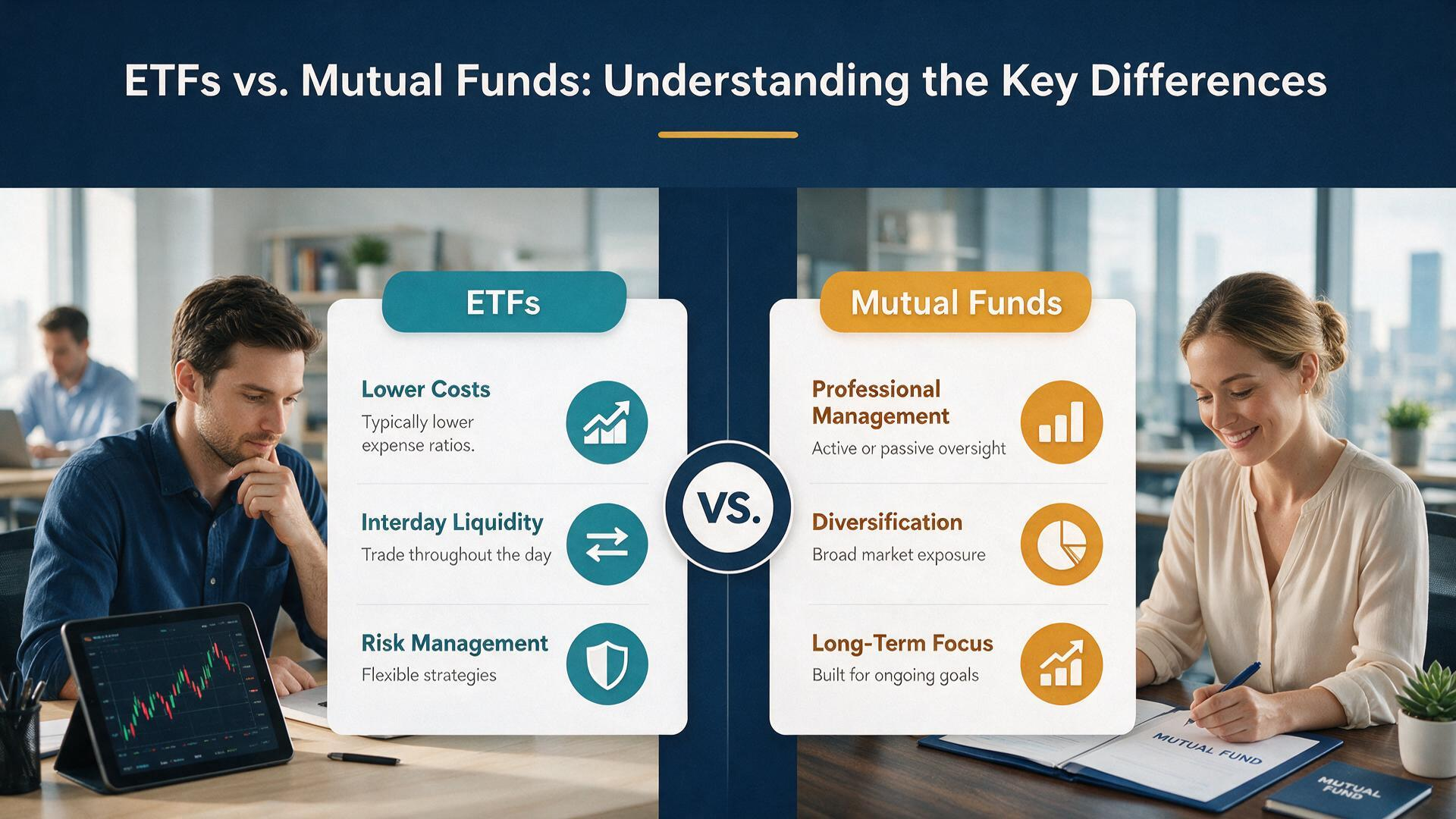
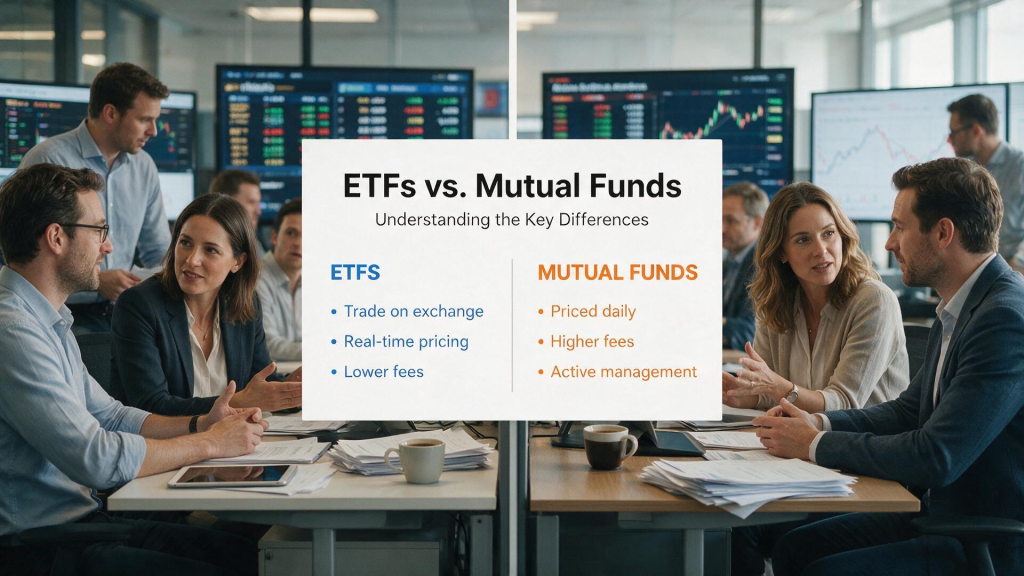
The core distinction comes down to structure. A mutual fund is priced once a day, after the market closes, and you buy or sell directly from the fund company. An ETF trades on an exchange throughout the day, like a stock, and you buy or sell from other investors in the market. That structural difference sounds technical, but it cascades into almost everything else: costs, taxes, minimums, and how you actually use the thing. The fund investment comparison that matters isn't about which one is "better" in the abstract. It's about which one fits the specific way you invest.
There's also a historical dimension worth knowing. Mutual funds have been around since the 1920s and became the default vehicle for retirement saving through 401(k) plans. ETFs arrived in the 1990s and grew up alongside the index fund revolution, which shaped their design around low costs and tax efficiency. That history explains why mutual funds still dominate retirement accounts while ETFs dominate taxable brokerage accounts. The two vehicles evolved for different purposes, and understanding those purposes helps you use them well.
The Trading Mechanics That Shape Everything
The most visible difference is how you buy and sell. With a mutual fund, you submit an order during the day and it executes at the end-of-day net asset value, or NAV. Everyone who bought or sold that day gets the same price, regardless of when they placed the order. That's convenient for people who don't want to think about timing, and it prevents the kind of impulsive intraday trading that can hurt returns [citation:1]. But it also means you don't know the exact price until after the fact, and you can't use limit orders or stop-losses to control your execution.
ETFs trade continuously during market hours. You can buy at 9:45 a.m. or sell at 3:30 p.m., and you see the price before you hit the button. You can use limit orders to specify the price you're willing to pay, and stop-loss orders to protect against sharp drops. That flexibility is valuable for anyone who wants precision, but it's also a temptation for people who shouldn't be trading frequently. The exchange traded funds structure rewards discipline, but it doesn't enforce it.
For long-term investors, the trading difference often doesn't matter much. If you're buying and holding for decades, the ability to trade at 2 p.m. instead of 4 p.m. is irrelevant. What matters more is what happens inside the fund. But for anyone who rebalances regularly, tax-loss harvests, or wants to control their cost basis precisely, the intraday pricing of ETFs is a genuine advantage. It's also worth noting that mutual funds can only be bought through the fund company or a brokerage that offers them, while ETFs can be bought through any brokerage account that trades stocks [citation:8].
The Cost Gap and What It Means for Returns
Costs are where the ETF advantage shows up most clearly, though the gap has narrowed for index funds. The average ETF charges significantly less than the average mutual fund, and the difference is especially stark in actively managed categories [citation:2][citation:4]. For index investors, the cheapest ETFs and the cheapest mutual funds are nearly identical—Vanguard's S&P 500 ETF charges 0.03% while its mutual fund equivalent charges 0.04%, a trivial difference [citation:1][citation:6]. But for active strategies, the gap is meaningful, and it compounds over time.
The cost difference isn't just about the expense ratio. Mutual funds sometimes carry sales loads, which are commissions paid when you buy or sell, and 12b-1 fees that cover marketing and distribution. ETFs generally avoid those charges, though they do have trading costs like bid-ask spreads that can add up if you trade frequently or choose less liquid funds [citation:4]. The ETF investment strategies that work best are built around low turnover and broad diversification, which keeps those trading costs minimal.
Over a long horizon, small cost differences become large. A fund charging 0.20% versus one charging 0.66% doesn't sound like a big deal, but on a $100,000 portfolio over thirty years, the difference can be tens of thousands of dollars. That's money that stays invested and compounds for you instead of going to the fund company. The lesson isn't that you should always pick the cheapest fund—quality and strategy matter—but that costs are one of the few variables you can control with certainty, and ignoring them is a choice that costs you.
The Tax Advantage That's Easy to Overlook
Tax efficiency is where ETFs have their strongest structural edge, and it's the reason many advisors recommend them for taxable accounts. The advantage comes from the in-kind redemption mechanism. When a mutual fund investor sells shares, the fund manager often has to sell underlying securities to raise cash for the redemption. If those securities have appreciated, the sale triggers a capital gain that gets distributed to all remaining shareholders—even those who didn't sell anything [citation:3][citation:10].
ETFs work differently. When an ETF investor sells, the shares trade on the exchange between investors, not back to the fund. And when large institutional investors redeem ETF shares, they receive a basket of the underlying securities rather than cash. No securities are sold at the fund level, so no capital gains are triggered, and no taxable distributions go out to shareholders [citation:3][citation:13]. The data is striking: in 2025, only 7% of ETFs paid a capital gain, compared with 52% of mutual funds [citation:3]. For active funds, the gap is even wider—9% of active ETFs versus 53% of active mutual funds [citation:3].
That difference matters most in taxable accounts. In a 401(k) or IRA, where taxes are deferred or tax-free, the structural advantage of ETFs is largely irrelevant [citation:5][citation:14]. But in a regular brokerage account, the tax drag from mutual fund distributions can be significant, especially for actively managed funds with high turnover. Over decades, the compounding effect of avoiding those distributions can add up to tens of thousands of dollars in additional after-tax wealth [citation:13]. The mutual fund investing approach that works for taxable accounts needs to account for this, either by favoring tax-efficient funds or by holding tax-inefficient funds in sheltered accounts.
Where Mutual Funds Still Make Sense
Despite the ETF advantages, mutual funds remain the better choice in several important situations. The most obvious is the 401(k). Most workplace retirement plans offer mutual funds, not ETFs, and that's not likely to change quickly [citation:1]. If your retirement savings are in a 401(k), you're probably using mutual funds whether you'd prefer ETFs or not. That's fine—inside a tax-deferred account, the tax efficiency difference disappears, and the convenience of automatic payroll contributions is valuable.
Automatic investing is another area where mutual funds shine. Most mutual funds support automatic investment plans that let you contribute a fixed dollar amount on a regular schedule, regardless of share price. ETFs have improved on this front, and many brokerages now offer fractional shares and automatic ETF purchases, but the infrastructure is still more mature for mutual funds [citation:15]. For investors who want to set up a systematic savings plan and not think about it, mutual funds are often the smoother path.
Mutual funds also offer advantages for investors who want to avoid the temptation of intraday trading. The once-a-day pricing structure removes the ability to react to every market wiggle, which for some people is a feature rather than a bug [citation:1]. And in some cases, institutional share classes of actively managed mutual funds carry competitive costs that rival ETF equivalents, especially for investors with larger balances who can access lower-fee share classes. The mutual fund selection process still matters, but the vehicle itself isn't obsolete.
Making the Choice for Your Portfolio
The practical answer for most investors is that both vehicles have a place. ETFs are generally better for taxable accounts, where their tax efficiency and low costs compound over time. Mutual funds are often better for tax-advantaged accounts, where those advantages don't matter and the convenience of automatic investing and 401(k) access is more valuable. Many investors end up using both, with ETFs in their brokerage accounts and mutual funds in their retirement accounts, and that's a perfectly reasonable approach.
The key is to understand what you're giving up with each choice. If you choose a mutual fund in a taxable account, you're accepting the possibility of capital gains distributions that you'll owe taxes on even if you didn't sell. If you choose an ETF, you're accepting the responsibility of trading during market hours and the potential for bid-ask spreads. Neither tradeoff is fatal, but knowing about them lets you make an informed decision rather than a default one. The exchange traded funds structure isn't universally superior—it's just better suited to certain situations.
It's also worth revisiting the choice periodically. Your account types may change, your tax situation may shift, and the fund landscape evolves constantly. A decision that made sense five years ago might not make sense today. The investors who do best are the ones who understand the tradeoffs, make deliberate choices, and stay willing to adjust when circumstances change. That's true for ETFs versus mutual funds, and it's true for almost everything else in investing.