 By admin
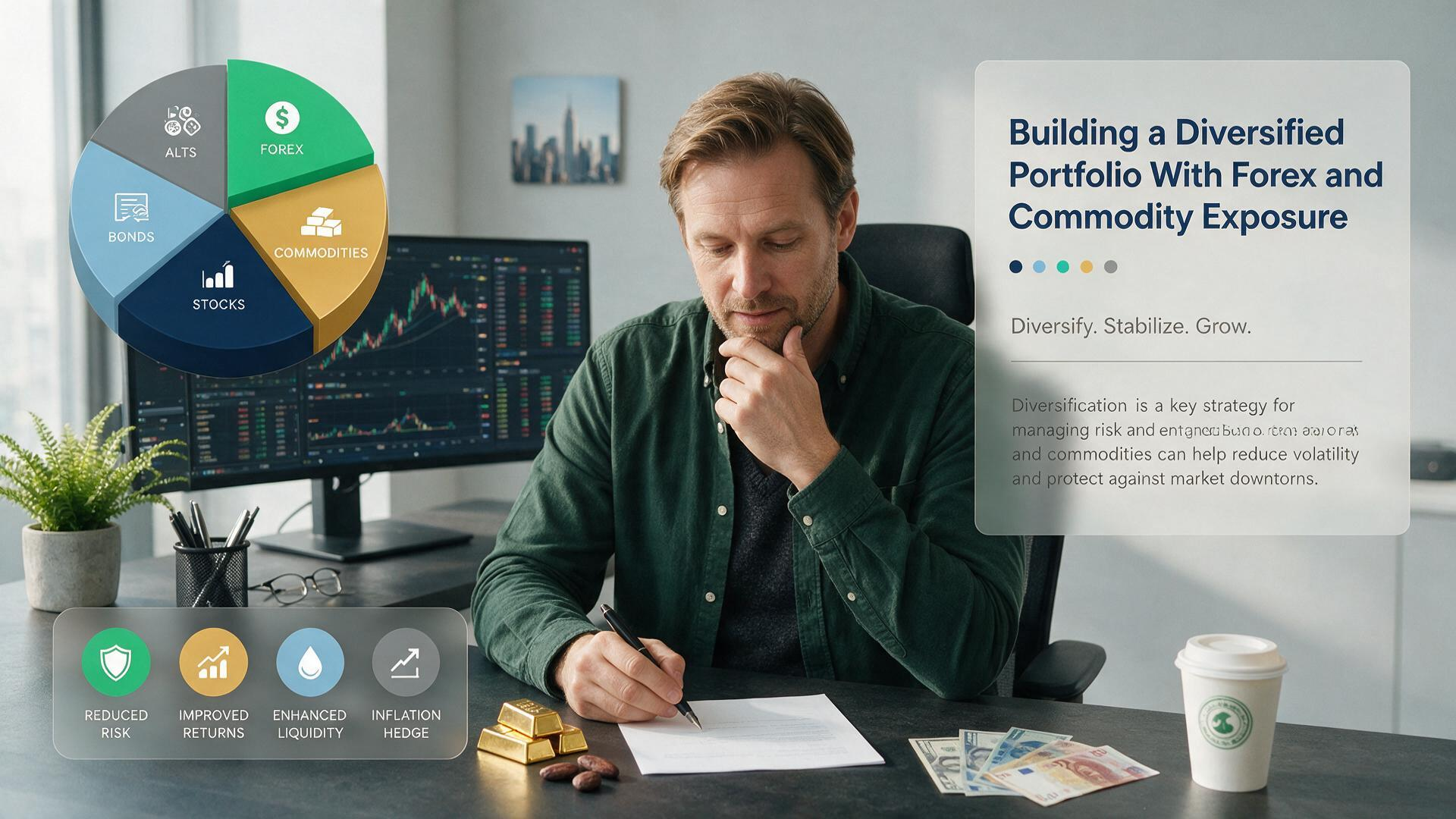
Why Forex and Commodities Belong in a Serious Portfolio
Most American investors build their portfolios from stocks and bonds. That's the standard advice, and it's served people well for generations. But it's not the whole universe of investable assets, and for investors who want to reduce correlation and add new sources of return, currency and commodity exposure can play a meaningful role. These aren't replacements for stocks and bonds—they're complements, providing diversification benefits that are hard to replicate with traditional assets. Building forex portfolio diversification and commodity exposure into a portfolio requires more thought than buying an index fund, but the effort can pay off in improved resilience and more consistent returns over time.
The core benefit is correlation. Stocks and bonds tend to move in relation to each other, sometimes positively and sometimes negatively, depending on the economic environment. But currencies and commodities respond to different forces. A commodity rally can happen while stocks are struggling. A currency move can be driven by central bank policy that has little to do with equity valuations. That low correlation is what makes these assets valuable as diversifiers—they give your portfolio exposure to different drivers of return, which reduces the risk that everything falls at once.
That's not to say that forex and commodities are risk-free. They're not. Both can be highly volatile, and both have their own specific risks. Currency markets can be moved by central bank decisions, geopolitical events, and shifts in risk appetite. Commodity markets can be disrupted by weather, supply shocks, and changes in global demand. Those risks are real, and they need to be managed carefully. But for investors who understand them, these asset classes can be useful tools for improving the overall risk-adjusted return of a portfolio. The key is to approach them with the same discipline you'd apply to any other investment.
The Role of Currency Exposure
Currency investment strategies range from simple to complex, and the right approach depends on your goals and your tolerance for complexity. For most individual investors, direct currency trading is too speculative to be a core strategy. But currency exposure can be added through other means—international stock and bond funds, currency-hedged and unhedged ETFs, and specialized currency funds. Each of these provides exposure to currency movements without requiring you to trade forex directly.
One of the most common approaches is to own international assets that are denominated in foreign currencies. If you own European stocks, you're exposed to the euro. If you own Japanese stocks, you're exposed to the yen. That exposure is a natural part of international diversification, and it provides some of the benefits of currency diversification without any additional effort. The tradeoff is that currency moves can amplify or offset your returns, depending on which direction they go. A weakening dollar boosts the returns of foreign assets for an American investor, while a strengthening dollar reduces them.
Currency-hedged funds are another option. These funds remove the currency exposure from international investments, so you get the return of the underlying assets without the effect of currency moves. That's useful for investors who want international diversification but don't want the added volatility of currency fluctuations. The tradeoff is that hedging costs money, and it removes the potential benefit of a favorable currency move. The forex portfolio diversification benefit is reduced, but the simplicity and predictability are improved.
For more sophisticated investors, direct currency trading or currency ETFs offer targeted exposure. These instruments allow you to take positions on specific currency pairs or baskets of currencies, and they can be used for hedging or speculation. They require more knowledge and attention than simply owning international stocks, but they offer more control. The investors who use them successfully are the ones who understand the forces that drive currency values and who have a clear thesis about where those values are headed. Without that understanding, direct currency trading is more likely to hurt than help.

Commodities as a Portfolio Diversifier
Commodity portfolio allocation is a more established practice than currency diversification, and there's a good reason for that. Commodities have a long history of providing diversification benefits, and they're accessible to individual investors through ETFs, mutual funds, and futures. The most common way to add commodity exposure is through a broad commodity index fund, which holds a diversified basket of energy, metals, and agricultural products. That approach gives you exposure to the asset class without requiring you to pick specific commodities.
Commodities serve several purposes in a portfolio. They can act as a hedge against inflation, because commodity prices tend to rise when inflation is rising. They can provide diversification benefits, because their returns have historically had low correlation with stocks and bonds. And they can offer exposure to economic growth, because demand for commodities tends to rise when the global economy is expanding. That combination of benefits is why many advisors recommend allocating a small percentage of a portfolio to commodities, often somewhere between 3% and 10%, depending on the investor's goals and risk tolerance.
Specific commodity exposure can be more targeted. Gold is the most popular commodity for individual investors, and it's often used as a hedge against currency debasement and geopolitical risk. Oil is another popular choice, particularly for investors who want to bet on energy prices or hedge against inflation. Industrial metals like copper offer exposure to global growth, while agricultural commodities offer exposure to weather and food prices. Each of these has its own drivers and its own risks, and the commodity risk management approach should reflect those differences.
It's important to understand the costs and mechanics of commodity investing. Commodity ETFs can have higher expense ratios than stock or bond funds, and some of them use futures contracts that involve roll costs. Those costs can drag on returns over time, especially in a contango market where future prices are higher than spot prices. Gold ETFs typically hold physical gold, which avoids roll costs but involves storage and insurance expenses. Understanding the costs is essential, because they can make the difference between a profitable allocation and a losing one.
How to Blend These Assets Into a Coherent Portfolio
The first step in building a portfolio with forex and commodity exposure is to decide what role each asset will play. Are you adding them for diversification, for inflation protection, for income, or for growth? Each goal calls for a different allocation and a different set of instruments. An investor who wants inflation protection might focus on gold and broad commodity funds. An investor who wants growth might focus on industrial metals and energy. An investor who wants diversification might use a broad basket of both. Being clear about the goal makes it easier to choose the right tools and to evaluate whether they're working.
Position sizing is the next consideration. Both forex and commodities can be volatile, and positions that are too large can overwhelm the diversification benefit with sheer price swings. A common approach is to keep each allocation modest—perhaps 5% to 10% for commodities and a similar range for currency exposure, depending on how it's implemented. The exact numbers should reflect your overall portfolio, your risk tolerance, and your time horizon. The goal isn't to maximize exposure to these assets; it's to capture their diversification benefits without letting them dominate your portfolio.
Rebalancing is what makes diversification work over time. When commodities rally and become a larger share of your portfolio, trimming them back locks in gains and keeps your risk level consistent. When they fall and become a smaller share, adding back means buying low. That process is the discipline that turns diversification from a theoretical concept into a practical benefit. It's not always easy to do, because it requires selling what's working and buying what's not, but it's the mechanism that captures the rebalancing premium. The alternative asset diversification benefit comes from this discipline, not from a static allocation.
Finally, be realistic about the complexity. Adding forex and commodities to your portfolio increases the number of things you need to monitor and the number of ways things can go wrong. For some investors, the additional complexity isn't worth it, and a simple stock-bond portfolio is the better choice. For others, the diversification benefits are worth the extra work. There's no universal right answer, but being honest about your own capacity to manage complexity is essential. A simple portfolio you understand is better than a complex one you don't, and that's true regardless of how many asset classes you include.
Common Mistakes to Avoid
The first mistake is chasing performance. Forex and commodity markets can produce spectacular returns during certain periods, and it's tempting to increase your allocation after a strong run. But those returns often reverse, and investors who chase them end up buying high and selling low. A disciplined approach means sticking to your target allocation and rebalancing regularly, regardless of recent performance. The currency investment strategies that work are patient and systematic, not reactive.
The second mistake is ignoring costs. Forex and commodity investments can be more expensive than stock and bond funds, and those costs can eat into returns over time. Trading costs, management fees, roll costs, and storage expenses all add up, and they need to be factored into your decisions. Choosing low-cost instruments and trading infrequently is a simple way to keep costs down. It's not the most exciting part of investing, but it's one of the most reliable ways to improve your outcomes.
The third mistake is overcomplicating. Forex and commodity markets are complex, and there's a temptation to use sophisticated strategies to try to capture every opportunity. But complexity often leads to mistakes, and mistakes are expensive. For most investors, a simple approach—broad commodity funds, international stock funds for currency exposure, and regular rebalancing—captures most of the benefits without the complexity. The investors who do best are usually the ones who keep things simple and stick to their plan.
The fourth mistake is ignoring correlation. Adding forex and commodities doesn't automatically diversify your portfolio if those assets are correlated with what you already own. Gold, for example, can be correlated with real interest rates, which also affect bonds. Oil can be correlated with energy stocks, which may already be in your portfolio. Understanding the correlations between your new assets and your existing holdings is essential for making sure you're actually diversifying. The commodity risk management process should include a review of how each new asset interacts with the rest of your portfolio, not just how it performs in isolation.
The bottom line is that forex and commodity exposure can be valuable additions to a diversified portfolio, but they're not magic bullets. They require understanding, discipline, and ongoing attention. The investors who benefit from them are the ones who approach them with realistic expectations, size them appropriately, and integrate them into a coherent overall strategy. Done well, they can improve resilience and reduce correlation. Done poorly, they can add risk without adding return. The difference is in the execution, and that's where the real work lies.