 By admin
The Rule That Trips Up Almost Everyone
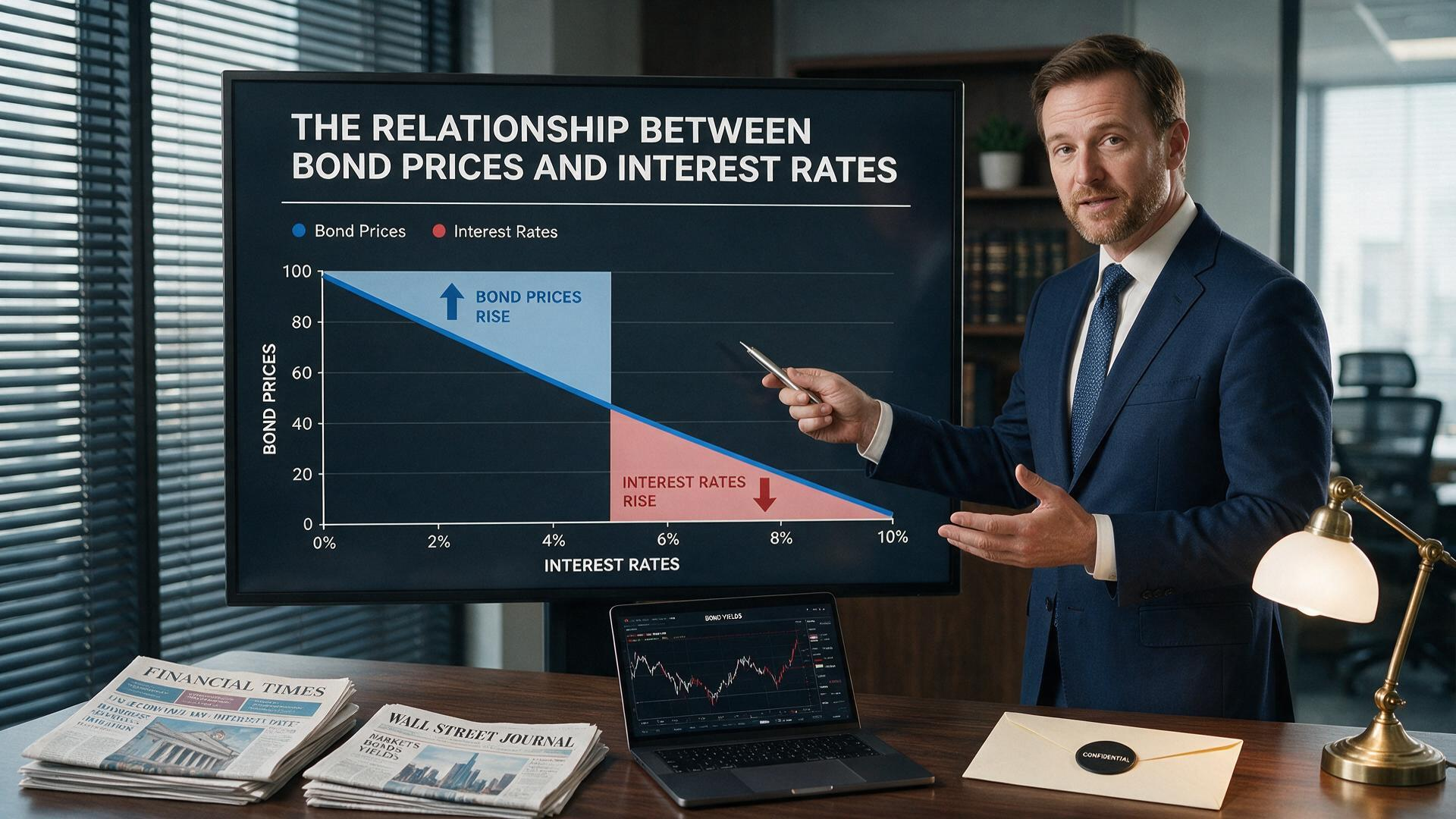
Here's a scenario that confuses a lot of investors. They buy a bond because it feels safe, then interest rates rise, and the bond loses value. They check their statement and see a loss on something they were told was conservative, and they don't understand why. The explanation comes down to one of the most fundamental relationships in finance: when rates go up, bond prices go down. It's a rule that sounds simple, but its implications are profound, and misunderstanding it has cost investors a lot of money over the years. The bond prices and interest rates relationship is the foundation of bond investment fundamentals, and getting it right is essential for anyone holding fixed income.
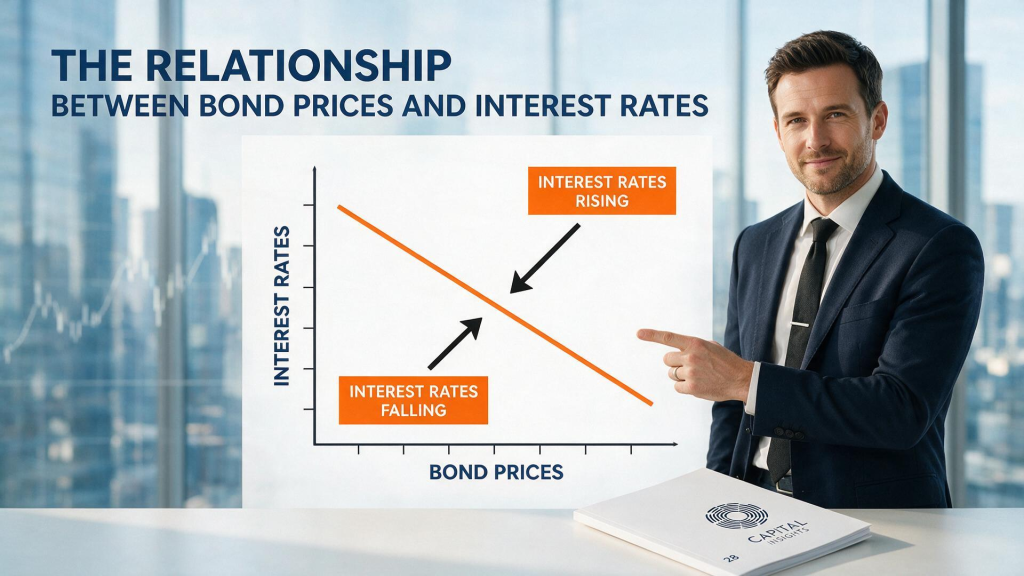
The reason for the inverse relationship is opportunity cost. Imagine you buy a bond paying 3% and rates then rise to 5%. New bonds now pay 5%, so your 3% bond is less attractive. If you wanted to sell it, you'd have to accept a lower price to compensate the buyer for the lower coupon. That's why prices fall when rates rise. The reverse is also true: if rates fall to 2%, your 3% bond becomes more valuable, because it pays more than new bonds, and buyers will pay a premium for it. The price adjusts so that the bond's yield matches what the market is offering on comparable securities.
What makes this tricky is that the price change is real, even though the coupon payments don't change. If you hold a bond to maturity, you'll get your principal back and the interim price swings won't matter. But if you need to sell before maturity, the price change becomes a real gain or loss. That's why the time horizon matters so much. The longer you can hold, the less the price swings matter. The shorter your horizon, the more they matter, because you're more likely to have to sell at an unfavorable price.
Why Prices Move When Rates Change
The mechanism that connects rates and bond prices runs through the yield. A bond's yield is the return an investor gets if they buy the bond at its current price and hold it to maturity. When the price falls, the yield rises, because the buyer is paying less for the same stream of payments. When the price rises, the yield falls. The market is constantly adjusting prices so that the yields on comparable bonds are in line with each other. If one bond offered a much higher yield than similar bonds, buyers would rush in, pushing its price up until the yield matched. That arbitrage process is what keeps the market efficient.
New bonds are issued at whatever rates are current at the time. If rates have risen since an older bond was issued, the older bond must trade at a discount to offer a competitive yield. If rates have fallen, the older bond trades at a premium. That's the mechanics of it. The bond market analysis that tracks new issuance and secondary market pricing is essentially tracking this adjustment process in real time. It's not a mysterious force—it's buyers and sellers negotiating a price that reflects current conditions.
The speed of the adjustment varies. In liquid markets like U.S. Treasuries, prices adjust almost instantly as news comes out. In less liquid markets like municipal bonds or corporate bonds, the adjustment can take longer, because there are fewer buyers and sellers and the price discovery process is slower. That's why you sometimes see price discrepancies between similar bonds in different markets. The market is always working toward equilibrium, but it doesn't always get there immediately. The fixed income securities that trade most actively tend to have the tightest pricing, while those that trade rarely can have wider spreads and slower adjustments.
It's also worth understanding that the market is pricing expectations, not just current rates. Bond prices move in anticipation of future rate changes as well as in response to current ones. If the market expects the Fed to raise rates, bond prices may fall before the rate hike actually happens, because traders are positioning for the move. That's why bond markets can seem to react to news that hasn't yet translated into actual rate changes. The market is always looking forward, and prices reflect what investors think is coming, not just what's already here.
Duration: The Measure of Sensitivity
Not all bonds respond to rate changes in the same way, and the measure of that sensitivity is called duration. Duration estimates how much a bond's price will change for a given change in rates. A bond with a duration of 5 years will lose roughly 5% of its value if rates rise by 1 percentage point, and gain roughly 5% if rates fall by 1 percentage point. A bond with a duration of 10 years will move roughly twice as much. That's a simplification—duration is a linear approximation of a nonlinear relationship—but it's a useful rule of thumb for understanding interest rate risk.
Duration is influenced by several factors. Longer maturities generally mean higher duration, because the bond's cash flows are spread out over more time and are more sensitive to discount rate changes. Lower coupons also mean higher duration, because more of the bond's total return comes from the final principal payment, which is further away. A zero-coupon bond has the highest duration for a given maturity, because all of its return comes at maturity. Understanding these relationships helps you assess how much rate risk you're taking with any given bond or bond fund.
Duration isn't the same as maturity, though people often confuse the two. Maturity is when the principal is repaid. Duration is the weighted average time until the bond's cash flows are received, accounting for the present value of each payment. A 10-year bond with a 5% coupon has a duration of about 8 years, because the coupon payments reduce the effective time until the investor has been repaid. A 10-year zero-coupon bond has a duration of exactly 10 years. The distinction matters because duration is the better measure of interest rate risk, and it's what bond fund managers use to manage their exposure.
For bond fund investors, duration is reported as a single number that describes the fund's overall sensitivity. A fund with an average duration of 6 years will lose roughly 6% of its value if rates rise by 1 percentage point, and gain roughly 6% if rates fall by 1 point. That's useful to know when you're choosing a fund, because it lets you match the fund's rate sensitivity to your own expectations and time horizon. If you think rates are likely to rise, you might favor shorter-duration funds. If you think they're likely to fall, you might favor longer-duration ones. The fixed income securities that make sense for you depend on your view of rates and your ability to tolerate the resulting price swings.
The Limits of the Relationship
The inverse relationship between rates and prices is one of the most reliable patterns in finance, but it's not a law of nature. There are periods when the relationship breaks down or behaves unexpectedly. In 2022, for example, both stocks and bonds fell as the Fed raised rates aggressively. The diversification benefit that investors had come to rely on didn't materialize, because the rate increases were so rapid and so large that they overwhelmed everything else. That was a reminder that the bond-price relationship is powerful but not universal, and that it can be overridden by other forces.
Inflation is one of those forces. When inflation is rising, the Fed tends to raise rates, which pushes bond prices down. But inflation also erodes the purchasing power of the bond's fixed payments, which makes bonds less attractive for other reasons. That's why inflation is often described as the enemy of bonds. The bond market analysis that ignores inflation is missing a key driver of both rates and bond values. The two are connected, and understanding that connection is essential for making good decisions.
Credit risk is another factor that can override the rate relationship. A corporate bond's price depends not just on rates but on the market's assessment of the issuer's ability to pay. If a company's credit quality deteriorates, its bonds can fall even if rates are falling. That's why credit analysis matters as much as rate analysis for corporate bond investors. The interest rate risk is only one of the risks you're taking when you buy a bond. Credit risk, liquidity risk, and inflation risk all play a role, and they can interact in complex ways.
The relationship also depends on the time horizon and the direction of travel. Over short periods, price swings can be large and unpredictable. Over longer periods, the coupon income tends to dominate, and the price swings matter less. That's why long-term bond investors tend to be less concerned with short-term rate movements than short-term traders. The bond investment fundamentals that matter for long-term investors are different from those that matter for traders, and understanding your own horizon is essential for choosing the right approach.
Applying This to Your Portfolio
The practical implication of the bond-price relationship is that you need to think about duration when you build a bond portfolio. If you're investing for the long term and can hold bonds to maturity, you can tolerate more duration risk because the price swings won't matter. If you might need to sell before maturity, you should favor shorter duration, because the price swings are smaller and more predictable. The right duration depends on your time horizon, your need for liquidity, and your view of where rates are headed. There's no single right answer, but there is a right answer for your situation.
Laddering is one way to manage duration risk. By holding bonds with a range of maturities, you spread your exposure across different points on the yield curve. When rates rise, the shorter bonds mature and can be reinvested at higher yields. When rates fall, the longer bonds benefit from price appreciation. The ladder smooths out the effect of rate changes and provides a predictable stream of maturing principal. It's not a perfect hedge, but it's a simple and effective way to manage the interest rate risk in a bond portfolio.
Bond funds offer a simpler way to get diversified exposure, but they come with their own considerations. A bond fund has a duration, and its price will move accordingly. A fund with a long duration is more sensitive to rate changes than one with a short duration, which is why understanding the fund's duration is essential before you buy. It's also worth understanding that bond funds don't mature, so you can't just hold them and wait for the price to recover the way you can with individual bonds. The bond investment fundamentals for funds are slightly different from those for individual bonds, and the choice between them depends on your goals and your need for predictability.
Finally, be realistic about what bonds can do for you. They provide income, stability, and diversification, but they're not immune to losses. The relationship between rates and prices means that bonds can lose value when rates rise, and that's a real risk that you need to accept if you're going to own them. The investors who do best with bonds are the ones who understand that tradeoff, who match their duration to their time horizon, and who don't panic when prices move against them. That's not the most exciting approach, but it's the one that works.