 By admin
Where the Income Actually Comes From
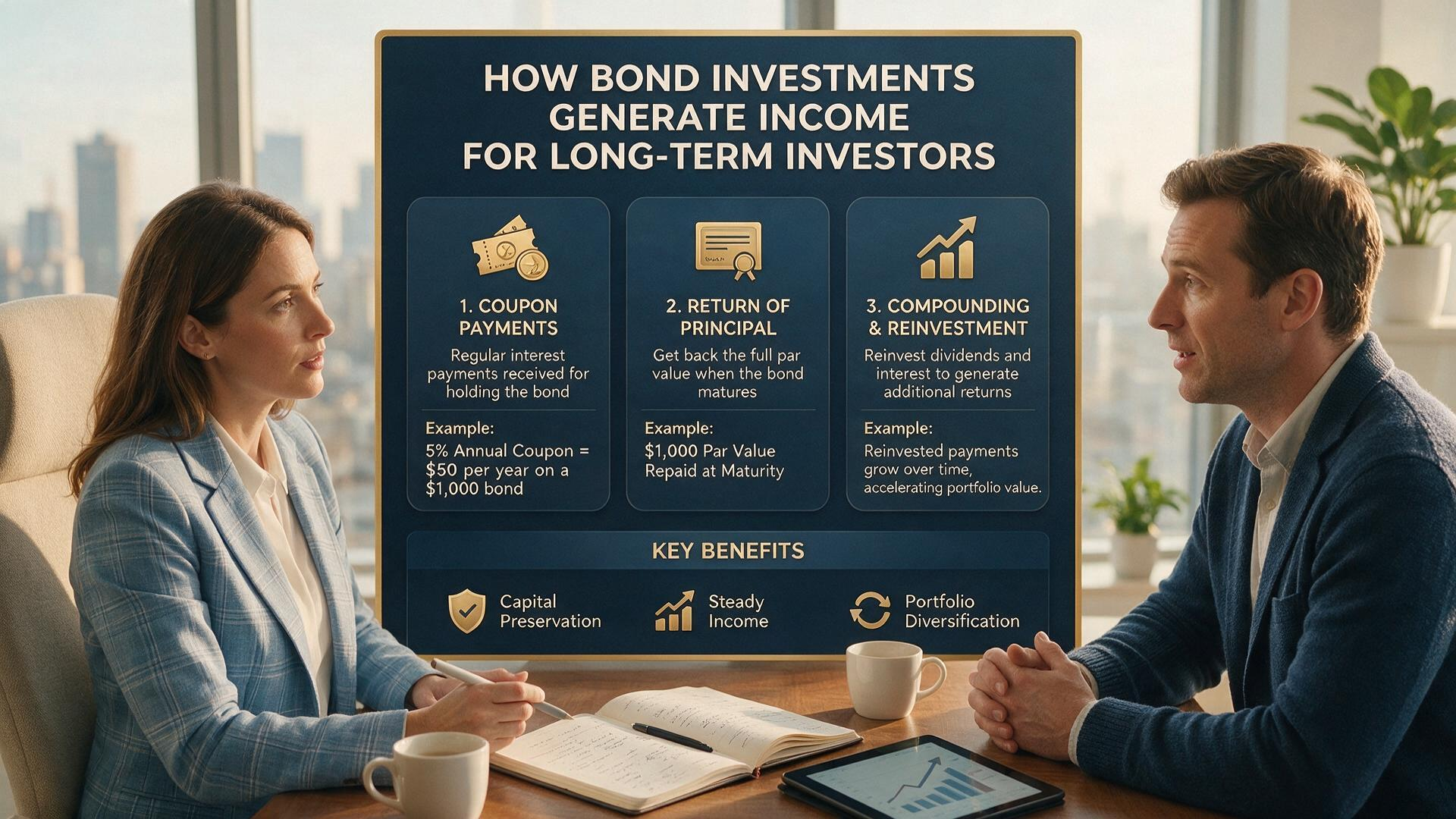
Bonds are one of the most misunderstood parts of an American investor's portfolio. Most people own them, often through a retirement fund they've never looked inside, and most people couldn't explain exactly how they produce income. That's a shame, because the mechanics are simpler than they look, and understanding them makes it much easier to decide whether bonds belong in your portfolio, how much to hold, and which kinds to buy. Bond investment strategies start with a clear picture of where the money comes from, and once that picture is in focus, the rest falls into place.
The basic structure of a bond is a loan. You lend money to a government, a municipality, or a corporation, and they promise to pay you interest on a set schedule and to return your principal when the bond matures. That interest is the income that bond investors talk about. It's contractual, which is a big part of the appeal. Unlike a stock dividend, which can be cut at any time, a bond payment is an obligation. If the issuer doesn't pay, it's a default, and that carries serious consequences for them. That reliability is why bonds have historically been the income backbone of conservative portfolios.
Bonds also generate income in a second way, through price appreciation. When interest rates fall, existing bonds become more valuable, because their fixed payments look more attractive relative to newly issued bonds with lower coupons. Investors can sell those bonds for a gain, or hold them and benefit from the higher relative yield. That's a different kind of return than the interest payment, but it's still part of the total return from fixed income investments. Understanding both sources of income is essential for building a bond strategy that actually works.
Coupon Payments and the Income Stream
The most direct source of bond income is the coupon payment. A bond's coupon is the interest rate it pays, expressed as a percentage of its face value. A $1,000 bond with a 4% coupon pays $40 a year, usually split into two semi-annual payments of $20. That's the income stream that bondholders rely on, and it continues until the bond matures or the issuer defaults. For investors who need regular cash flow, coupon payments are the part of bond investing that matters most.
The coupon isn't always the same as the yield. If you buy a bond at a discount to its face value, your yield will be higher than the coupon, because you're getting both the interest payments and the gain from the bond maturing at par. If you buy at a premium, your yield will be lower than the coupon, because you're paying more than face value and will lose that premium at maturity. That's why investors look at yield to maturity, which accounts for both the coupon and the price paid, rather than just the coupon alone. The bond income generation that matters is the total return, not just the headline coupon rate.
Coupon frequency varies. Most U.S. bonds pay semi-annually, but some pay quarterly or annually, and some pay no coupon at all. Zero-coupon bonds are sold at a deep discount and pay no interest along the way. Instead, they pay the face value at maturity, and the investor's return comes entirely from the price appreciation. Those bonds are useful for specific goals, like funding a known expense at a known date, but they don't provide the regular income stream that most retirees want. The right choice depends on what you need the money to do.
The security of the coupon depends on the issuer. U.S. Treasury bonds are backed by the full faith and credit of the federal government, which makes them among the safest income investments in the world. Corporate bonds carry credit risk, meaning the issuer might default, which is why they pay higher coupons to compensate. Municipal bonds are issued by states and local governments and are often exempt from federal income tax, which can make their after-tax yield attractive for high-income investors. The long-term bond investing approach that works is built around matching the credit quality of the issuer to the role the bond plays in your portfolio.

Price Movements and Total Return
The second source of bond income is price appreciation, and it's the part that's easiest to forget. Bonds trade in a market, and their prices move in response to changes in interest rates. When rates fall, existing bonds become more valuable, because their coupons are higher than what new bonds offer. When rates rise, existing bonds lose value, because their coupons are lower than what new bonds offer. That inverse relationship between rates and bond prices is one of the most fundamental rules of fixed income investing.
The sensitivity of a bond's price to rate changes is measured by duration. A bond with a longer duration is more sensitive to rate changes than one with a shorter duration. That's why long-term bonds can be volatile, even though they're considered safe in terms of credit risk. A 1% change in rates can move a long-duration bond's price by 10% or more, which is a much bigger swing than most people expect from a "safe" investment. The bond investment strategies that work account for duration risk, not just credit risk, because both can affect your returns significantly.
For long-term investors, price movements can be an opportunity rather than a problem. When rates rise and bond prices fall, new investors can buy bonds at higher yields, which means more income over the life of the bond. Existing holders see the value of their bonds decline, but if they hold to maturity, they get their principal back and the price decline is temporary. That's why the time horizon matters so much in bond investing. If you're buying bonds to fund a liability that's decades away, short-term price swings are noise. If you're buying bonds you might need to sell in a year, price swings can be a real risk.
Total return combines the coupon income and the price change, and it's the measure that matters for investors who are reinvesting their income rather than spending it. A bond with a 4% coupon that appreciates 2% in price has a total return of roughly 6%. A bond with a 4% coupon that depreciates 2% has a total return of roughly 2%. The fixed income portfolio that generates the best long-term returns is the one that balances coupon income with price stability, rather than maximizing one at the expense of the other.
Building a Portfolio That Pays You Reliably
The foundation of a reliable bond income portfolio is diversification across issuers, maturities, and credit qualities. Owning bonds from a single issuer concentrates risk, even if that issuer is the U.S. Treasury. Owning bonds that all mature at the same time concentrates interest rate risk, because you'll have to reinvest the proceeds at whatever rates are available when they mature. Owning bonds that all have the same credit rating concentrates credit risk, because a downturn in that segment could hit your whole portfolio at once. Spreading across all three dimensions is what makes bond income reliable.
Laddering is a popular strategy for managing interest rate risk and generating steady income. The idea is to own bonds with a range of maturities, from short to long, so that some bonds mature every year. When rates rise, the maturing bonds can be reinvested at higher yields. When rates fall, the longer-dated bonds in the ladder benefit from price appreciation. The ladder smooths out the effect of rate changes and provides a predictable stream of maturing principal that can be spent or reinvested. It's a simple approach, but it's one of the most effective for long-term income investors.
Credit quality should reflect the role the bonds play. For money you can't afford to lose, Treasuries and high-quality corporate bonds are the right choice. For money you can afford to take more risk with, high-yield bonds offer higher coupons but come with higher default risk. The gap between high-quality and high-yield yields is compensation for that risk, and it widens during periods of stress. The bond income generation that's sustainable comes from a portfolio that matches credit quality to your risk tolerance, rather than reaching for yield without considering the downside.
Taxes are another consideration that's easy to overlook. Interest income from corporate bonds is taxed as ordinary income, which is the highest rate for most investors. Municipal bonds are often exempt from federal tax, and sometimes from state tax as well, which can make their after-tax yield higher than a taxable bond with a higher coupon. Treasury bonds are exempt from state and local taxes, which makes them more attractive for investors in high-tax states. The fixed income investments that make sense for you depend on your tax situation, not just the headline yield.
How Bonds Fit Into a Long-Term Plan
Bonds serve several roles in a long-term portfolio, and the right allocation depends on which roles matter most to you. The first is income. If you're retired or approaching retirement, the regular coupon payments from bonds can fund your expenses without forcing you to sell assets during a downturn. That's a powerful benefit, because selling stocks when they're down locks in losses and can derail a retirement plan. Bonds provide a buffer that lets you ride out the bad years.
The second role is stability. Bonds are generally less volatile than stocks, and they tend to hold up better during equity market downturns. That doesn't mean they never fall—2022 was a painful year for bonds, as rising rates pushed prices down—but over most historical periods, a portfolio with bonds has been less volatile than one without. That stability is valuable not just for your peace of mind, but for your ability to stay invested. Investors who can't handle the volatility of an all-stock portfolio often sell at the bottom, which is the worst possible outcome. The long-term bond investing approach that works accepts that bonds aren't always exciting, but appreciates that excitement isn't the goal.
The third role is diversification. Bonds and stocks don't always move together, and in many periods they've been negatively correlated or only weakly correlated. That means owning both can reduce the overall volatility of a portfolio without reducing its expected return as much as you'd expect from holding more of the lower-returning asset. The diversification benefit is one of the main reasons most financial advisors recommend holding some bonds, even for aggressive investors. It's not about avoiding risk—it's about spreading it across different sources.
Finally, bonds provide flexibility. They can be sold to raise cash, used as collateral, or held to maturity for a known return. That flexibility is valuable in a financial plan, because life rarely goes according to plan. Having a portion of your portfolio in liquid, relatively stable assets means you don't have to sell stocks at a bad time when an unexpected expense arises. The fixed income portfolio that works isn't necessarily the one with the highest yield. It's the one that gives you the income, stability, and flexibility you need to stay on track with your long-term goals.