 By admin
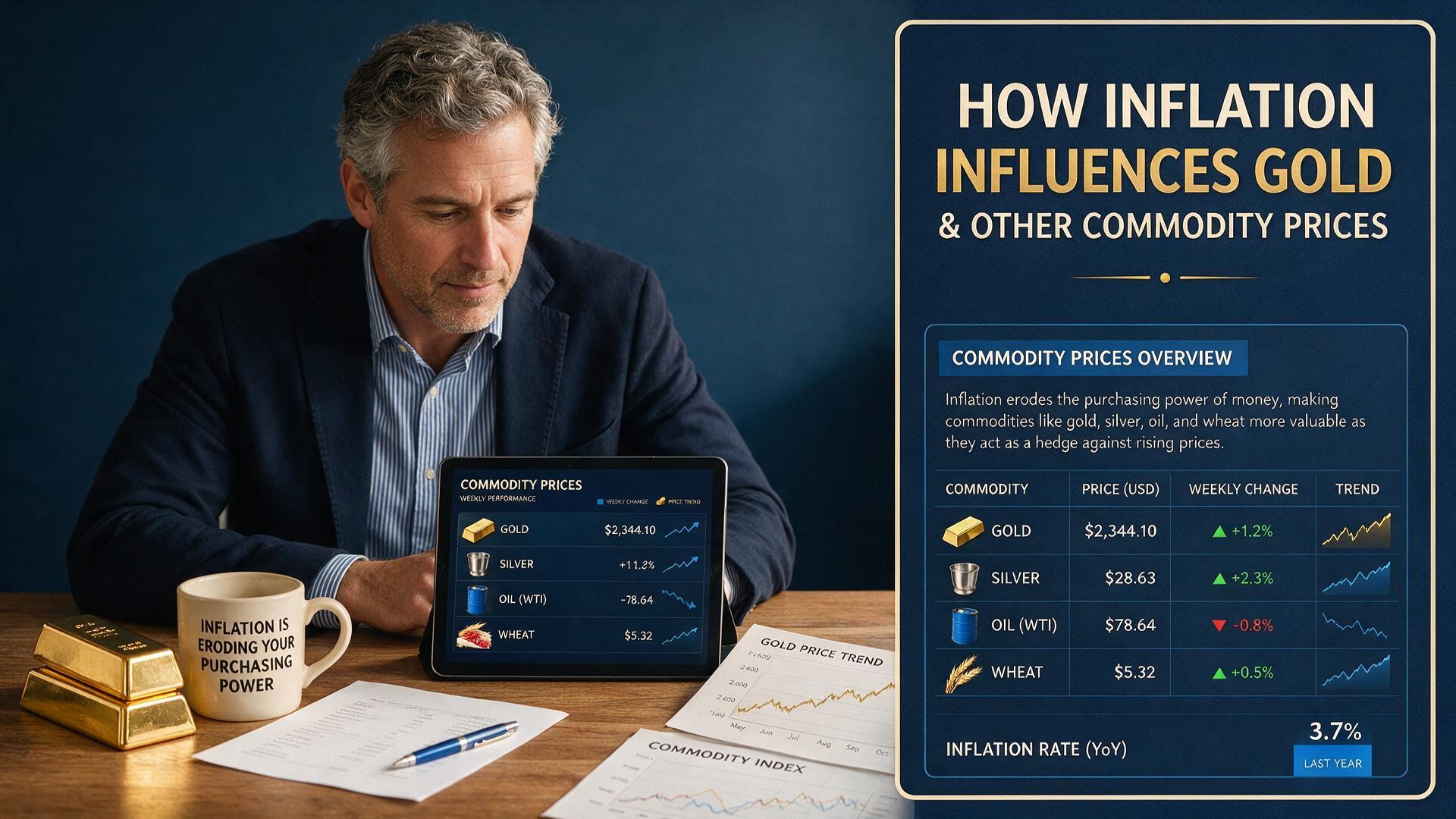
Inflation Doesn't Always Push Commodities Higher
The textbook version of inflation hedging sounds straightforward. Prices rise, so you buy assets that rise with them. Gold and commodities are supposed to be those assets. But anyone who's actually traded these markets knows the reality is far messier. Inflation can push gold higher, but it can also push it lower, and the same is true for copper, oil, and agricultural products. The difference comes down to inflation and gold prices working through different channels at different times, and understanding those channels is essential if you want to use commodities as a hedge rather than a headache.
The confusion starts with a misunderstanding of what inflation actually does. Rising consumer prices don't automatically translate into higher commodity prices. Sometimes inflation is driven by strong demand, which is good for commodities. Sometimes it's driven by supply shocks, which can be good for some commodities and terrible for others. And sometimes inflation forces central banks to raise interest rates, which is often bad for gold and other precious metals because it raises the opportunity cost of holding assets that don't pay interest. The same inflation data can produce opposite reactions in the same commodity depending on which of these forces is dominant.
That's why the relationship between inflation and commodities is one of the most misunderstood topics in investing. People see the word inflation and assume gold goes up, oil goes up, everything goes up. But the commodity market trends of recent years tell a different story. In periods when inflation forced aggressive rate hikes, gold fell even as consumer prices rose. In periods when inflation was driven by energy supply shocks, oil soared while industrial metals slumped. The lesson is that you can't just buy commodities and call it an inflation hedge. You have to understand which commodity, which inflation, and which policy response.
Why Gold Doesn't Always Follow Inflation
Gold is the asset most associated with inflation protection, and for good reason. It has a long history as a store of value, it can't be printed, and it has survived every currency regime in modern history. Over very long periods, gold has roughly kept pace with inflation, and in some inflationary episodes it's done much better. But the short and medium-term relationship is far less reliable, and the reason comes down to real interest rates.
Gold pays no interest. That's its defining characteristic as an investment. When real interest rates are low or negative, the opportunity cost of holding gold is small, and the metal becomes more attractive. When real rates are high, holding gold means giving up a meaningful return on cash or bonds, and the metal struggles. That's why periods of aggressive rate hikes tend to be bad for gold, even when inflation is high. The Fed is raising rates precisely to fight inflation, and the higher real yields that result put pressure on gold prices.
Recent market action illustrates this clearly. Hotter-than-expected inflation data in late 2026 pushed gold below $4,000 an ounce, not because inflation was bad for gold in theory, but because the data increased expectations for Fed rate hikes, which pushed real yields and the dollar higher [citation:3][citation:5]. The market wasn't trading inflation. It was trading the policy response to inflation, and that response was negative for a non-yielding asset. Understanding that distinction is the key to understanding gold's behavior.
There's another layer to this. Gold's relationship with real rates is strongest when rates are low, and much weaker when rates are high [citation:10]. That means the traditional inverse relationship that investors rely on doesn't always hold. When real rates are already elevated, further increases may not hurt gold as much, because the opportunity cost argument becomes less relevant at the margin. That's a nuance that gets lost in most discussions of gold and inflation, but it matters for anyone trying to time entries or exits.

The Structural Forces That Support Gold
Despite the short-term pressure from rates, gold has a structural bid that's kept it from falling further. The most important source of that demand is central banks. They've been buying gold consistently for years, not as a tactical trade but as a strategic decision to diversify reserves away from currencies and counterparties. In the first quarter of 2026 alone, central banks purchased roughly 244 tons, which annualized would be the fourth-highest demand since 1950 [citation:1]. That kind of buying doesn't stop because the price dips.
The logic behind central bank buying is worth understanding. Gold carries no counterparty risk. It's not anyone's liability, it can't be frozen by sanctions, and it doesn't depend on a government's creditworthiness. In a world of geopolitical fragmentation and rising sovereign debt, those properties become more valuable. Central banks aren't buying gold because they expect inflation to spike next quarter. They're buying it because they want a reserve asset that isn't tied to any other nation's policy. That's a structural shift, and it provides a floor under prices that didn't exist a decade ago.
Fiscal deficits are another structural support. Government debt levels across major economies are high and rising, and the cost of servicing that debt is consuming a growing share of budgets. That creates a long-term inflation risk and raises questions about the creditworthiness of sovereign bonds. Gold benefits from that anxiety, because it's an alternative to fiat currencies and government debt. It doesn't pay interest, but it also doesn't depend on a government's ability to tax and borrow. When investors worry about fiscal sustainability, gold becomes more attractive.
That doesn't mean gold will go up every year. It won't. The metal can spend years consolidating or declining while these structural forces build. But the presence of persistent central bank demand and the fiscal backdrop mean that the downside is likely more limited than it would be otherwise. For gold investment strategies, that means thinking of gold as a strategic diversifier rather than a tactical inflation trade. It's not a position you put on when CPI comes in hot. It's a position you hold because the financial system has vulnerabilities that gold helps protect against.
Commodities Beyond Gold: Energy and Metals
Gold gets most of the inflation-hedge attention, but other commodities have their own relationships with inflation, and they work differently. Energy is the most direct. Oil and natural gas prices are a major component of inflation itself, so when energy prices rise, they push inflation higher. That makes energy commodities a natural hedge against energy-driven inflation, because the asset and the inflation are driven by the same underlying force. But it also makes them volatile, because supply shocks can reverse quickly.
Industrial metals like copper and aluminum are more tied to economic growth than to inflation directly. They're used in construction, manufacturing, and infrastructure, so their demand depends on how much economic activity is happening. Inflation can be good for metals if it's driven by strong demand, but it can be bad if it forces central banks to tighten policy and slow the economy. That's the tension that plays out in metal markets during inflationary periods. The inflation hedging assets label doesn't apply equally to all commodities, and treating them as interchangeable is a mistake.
Agricultural commodities have their own dynamics. Weather, harvests, and global trade flows drive prices more than inflation does in the short term. Over longer periods, agricultural prices tend to track inflation because farming costs rise with the general price level. But the short-term volatility is enormous, and it's driven by factors that have nothing to do with monetary policy. Investors looking for inflation protection in agriculture need to understand those dynamics, because the correlation with inflation is weaker and less reliable than it is for energy or gold.
The practical implication is that commodity exposure should be diversified if you're using it as an inflation hedge. Relying on gold alone leaves you exposed to the real rate channel. Relying on energy alone leaves you exposed to supply shocks. A blend of precious metals, energy, and industrial metals gives you exposure to different inflation channels, which makes the hedge more robust. It also reduces the volatility of the overall position, because the different commodities don't always move together.
Building a Sensible Approach to Inflation Protection
If you're going to use commodities for inflation protection, the first step is to be clear about what you're protecting against. Are you worried about a temporary spike in energy prices? A long period of elevated inflation? A crisis of confidence in fiat currencies? Each of those scenarios calls for a different mix of assets. Gold protects against currency debasement and geopolitical risk. Energy protects against energy-driven inflation. Industrial metals protect against demand-driven inflation. Tying the allocation to the specific risk you're worried about is more effective than buying a generic commodity fund and hoping for the best.
Position sizing matters as much as selection. Commodities are volatile, and they can underperform for years. The precious metals market in particular has long periods of consolidation that test the patience of even committed holders. A modest allocation, sized so that a drawdown doesn't derail your overall portfolio, is more sustainable than a large bet that you'll be forced to abandon at the wrong time. Many advisors suggest keeping commodity exposure to a small percentage of total assets, with the exact number depending on your risk tolerance and the role the position is playing.
Timing is the hardest part, and it's worth being honest about the limitations. Nobody can consistently predict inflation, rate hikes, or commodity prices. The investors who do best with commodities are usually the ones who hold them as a long-term diversifier and rebalance periodically, rather than trying to trade in and out based on economic forecasts. Rebalancing forces you to sell when prices are high and buy when they're low, which is a disciplined way to take advantage of volatility without needing to predict it.
Finally, keep the bigger picture in mind. Commodities and gold are tools, not solutions. They can protect against certain risks, but they come with their own risks and their own opportunity costs. The most robust inflation protection usually comes from a combination of assets: equities with pricing power, real estate, inflation-linked bonds, and commodities. Each has its strengths and weaknesses, and together they provide more reliable protection than any single asset could. Gold and commodities deserve a place in that mix, but they work best when they're part of a diversified strategy rather than a concentrated bet on a single economic outcome.