 By admin
Finance Without the Middlemen
The phrase decentralized finance gets thrown around a lot, and like most phrases in crypto, it means different things to different people. Strip it down to its essentials and the idea is straightforward: take the financial services that banks and brokerages have provided for centuries — lending, borrowing, trading, earning interest — and rebuild them on blockchain networks so that they run automatically, without a company in the middle taking a cut and deciding who gets access. That's the promise behind decentralized finance, and while the reality is messier than the promise, the underlying idea has genuine substance.
What makes DeFi different from a traditional bank isn't just the technology. It's the structure. When you deposit money at a bank, you're trusting the bank to manage it responsibly, to pay you interest, and to return your funds when you ask. The bank decides who gets loans, sets the interest rates, and keeps the spread between what it earns and what it pays you. DeFi replaces that structure with smart contracts — self-executing code that handles the same functions according to rules that are visible to everyone and can't be changed on a whim. The lending pool doesn't have a loan officer. It has code, and the code does the job.
That shift has real consequences, both good and bad. On the good side, DeFi is open. Anyone with an internet connection and a wallet can participate, regardless of where they live or whether they have a credit history. The rules are transparent, the fees are often lower, and the services are available 24 hours a day. On the bad side, there's no customer service line, no one to call if something goes wrong, and no insurance if a smart contract gets exploited. The freedom comes with responsibility, and the responsibility is heavier than most people expect. Understanding both sides is the starting point for evaluating the DeFi investment opportunities that the space offers.
The Core Building Blocks of DeFi
DeFi protocols are the individual applications that make up the ecosystem, and they tend to fall into a few main categories. The first is lending and borrowing. Protocols like Aave and Compound let users deposit assets to earn interest or borrow against collateral. The interest rates aren't set by a committee — they're determined by supply and demand, adjusting automatically as more people lend or borrow. The collateral is held by the protocol and liquidated automatically if its value falls too far, which protects lenders from default risk. It's an elegant system, though it depends on the collateral being liquid enough to sell during a crisis.
The second category is decentralized exchanges, or DEXs. These platforms let users trade one token for another without an intermediary, using automated market makers that price assets based on the balance of a liquidity pool. Instead of matching buyers and sellers like a traditional exchange, the pool holds reserves of both assets and adjusts the price as trades happen. Users who provide liquidity to the pool earn fees from the traders, which is one of the main ways to generate yield in DeFi. The model works well for most trades, though it can break down during extreme volatility.
Stablecoins deserve mention as the connective tissue of the DeFi ecosystem. Most lending, borrowing, and trading in DeFi uses stablecoins as the unit of account, because they provide a stable reference point in a market that's anything but stable. The growth of DeFi has gone hand in hand with the growth of stablecoins, and the health of the two is intertwined. If stablecoins lose their peg, DeFi protocols that rely on them would face serious problems, which is one of the systemic risks worth understanding.
Beyond those core categories, there's a wide range of other protocols: yield aggregators that automatically move funds to the highest-yielding opportunities, derivatives platforms that let you trade synthetic assets, insurance protocols that cover smart contract risk, and more. Each has its own mechanics and its own risks, and the complexity increases as you go further out. For most investors, the core categories are the place to start, and the more exotic protocols are better left to people who understand them deeply.
Where the Investment Opportunities Are
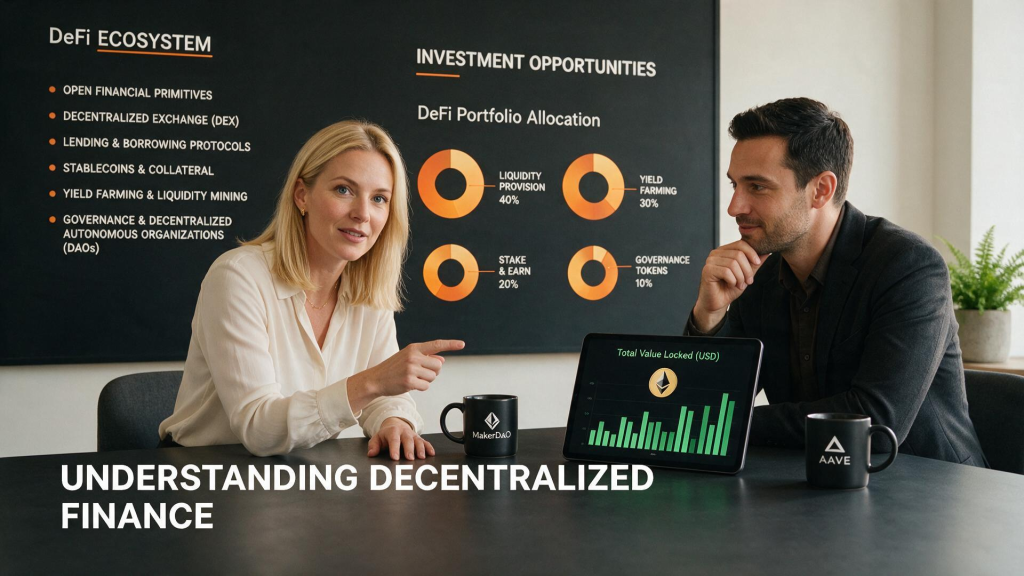
The most straightforward way to participate in DeFi is through lending and liquidity provision. Lending stablecoins or major cryptocurrencies to a protocol can earn yields that are often higher than what you'd get from a traditional savings account, though the rates fluctuate and can drop significantly when demand is low. Providing liquidity to a DEX can earn trading fees, but it also exposes you to impermanent loss, which happens when the price of the assets in the pool diverges. The yields can be attractive, but they're not free, and understanding where they come from is essential.
Yield farming is the more active version of this. Yield farmers move their capital between protocols to chase the highest returns, often earning additional tokens as rewards on top of the base yield. The rewards can be substantial, but they're usually paid in tokens that may lose value, and the strategies can be complex. The high yields often come with high risk, and many yield farmers have ended up with less than they started with after accounting for impermanent loss, token depreciation, and gas fees. It's a game that rewards knowledge and attention, and it punishes people who chase the highest number without understanding the mechanics.
Another approach is investing in the governance tokens of DeFi protocols. These tokens give holders a say in how the protocol operates and often benefit from the growth of the platform. If a protocol becomes widely used, its token may appreciate, and holders may receive a share of the fees the protocol generates. The catch is that governance tokens are highly volatile, and their value depends on the continued success of the protocol. Many DeFi tokens have fallen dramatically from their peaks, and the competition among protocols is intense. Picking the winners is difficult, which is why diversification across several protocols is usually wiser than betting everything on one.
There are also indirect ways to get exposure to DeFi. Some publicly traded companies have exposure to the space, either by holding crypto assets or by building infrastructure for the ecosystem. Exchange-traded products that track DeFi tokens exist in some jurisdictions, though they may not be available everywhere. And some venture funds specialize in early-stage DeFi investments, though those are typically limited to accredited investors. For most people, the direct route through tokens is the most accessible, but it's also the most volatile, and position sizing matters enormously.
The Risks That Come With the Opportunity
Smart contract risk is the most fundamental risk in DeFi, and it's one that's easy to underestimate. Every protocol is code, and code can have bugs. Even audited protocols have been exploited, and the losses can be total. The most famous example is the collapse of several major DeFi projects over the years, but smaller exploits happen regularly. Spreading your exposure across multiple protocols reduces the risk that a single exploit wipes you out, and using protocols that have been audited and battle-tested reduces it further. But no protocol is entirely safe, and anyone using DeFi should be prepared for the possibility that a protocol they use could fail.
Liquidity risk is another concern. DeFi protocols depend on having enough liquidity to function, and when liquidity dries up, the consequences can be severe. During a market crash, traders may rush to exit positions, and the automated market makers that price assets may not be able to keep up. Slippage increases, and some users may not be able to exit at any reasonable price. The risk is higher for smaller protocols and newer tokens, and it's one of the reasons that well-established protocols with deep liquidity are generally safer than newer or smaller ones.
Governance risk is a subtle but important factor. Many DeFi protocols are governed by token holders, who vote on changes to the protocol. If a malicious or incompetent group gains control of enough tokens, they could change the rules in ways that benefit themselves at the expense of other users. Governance attacks have happened, and they're likely to happen again. The risk is higher for protocols with concentrated token ownership or low voter participation, and understanding the governance structure is part of evaluating any DeFi investment.
Regulatory risk is also significant and likely to grow. DeFi has attracted the attention of regulators around the world, and the rules are still being written. Some jurisdictions have taken a hostile stance, while others have been more accommodating. Changes in regulation could affect which protocols can operate, how they're taxed, and who can use them. Staying informed about the regulatory landscape is important, and diversifying across protocols with different regulatory profiles can help reduce the risk. That said, the entire space is subject to regulatory uncertainty, and that's one of the reasons to keep your overall exposure modest.
Making Sense of the DeFi Market
DeFi market analysis is complicated by the fact that the sector moves quickly and the metrics aren't always reliable. Total value locked, or TVL, is the most commonly cited figure, and it measures the amount of assets deposited in DeFi protocols. It's a useful indicator of activity, but it can be inflated by double counting and by tokens that are created out of thin air. It also tends to rise during bull markets and fall during bear markets, which makes it more of a sentiment indicator than a fundamental one. Treating TVL as a definitive measure of value is a mistake, but it's a useful starting point.
Revenue and fees are more meaningful metrics, because they reflect actual usage. A protocol that generates substantial fees from real users is more valuable than one that's only attracting deposits through token incentives. Comparing fees to the value of the token can give you a sense of whether the valuation is reasonable, similar to how price-to-earnings works for stocks. The analysis is less mature than in traditional finance, and the comparisons aren't perfect, but they're a better guide than looking at price alone.
Developer activity is another indicator worth watching. Protocols with active development teams are more likely to improve, adapt, and stay relevant. GitHub activity, the number of developers contributing, and the frequency of upgrades all provide clues about whether a protocol is being actively maintained or is slowly being abandoned. The space evolves quickly, and protocols that don't keep up tend to fall behind. Following the development of the protocols you invest in is part of staying informed about decentralized financial services.
Finally, keep an eye on the broader trends in the space. DeFi has gone through several cycles of hype and consolidation, and each cycle has left behind stronger, more useful protocols. The current focus on real-world assets, institutional adoption, and improved user experience suggests that the space is maturing, even if the speculation hasn't gone away entirely. The investors who do best are the ones who combine enthusiasm for the technology with a clear-eyed view of the risks and a disciplined approach to position sizing. DeFi is a fascinating space with real potential, but it's also a place where people lose money quickly. Respecting both sides of that equation is the key to participating intelligently.