 By admin
The Debate That Never Ends
Walk into any room of investors and sooner or later someone will ask the question: growth or value? It's been argued over for decades, and the answer changes depending on who you ask, what decade you're in, and which side of the market has been winning lately. The truth is that both approaches have made people rich, both have endured long stretches of misery, and neither is objectively superior in every situation. What matters is understanding how each works, what you're actually buying when you choose one, and whether the approach fits your temperament and goals. This isn't a battle with a winner and a loser — it's a choice between two very different ways of thinking about stock investment comparison, and the smartest investors learn to appreciate both.
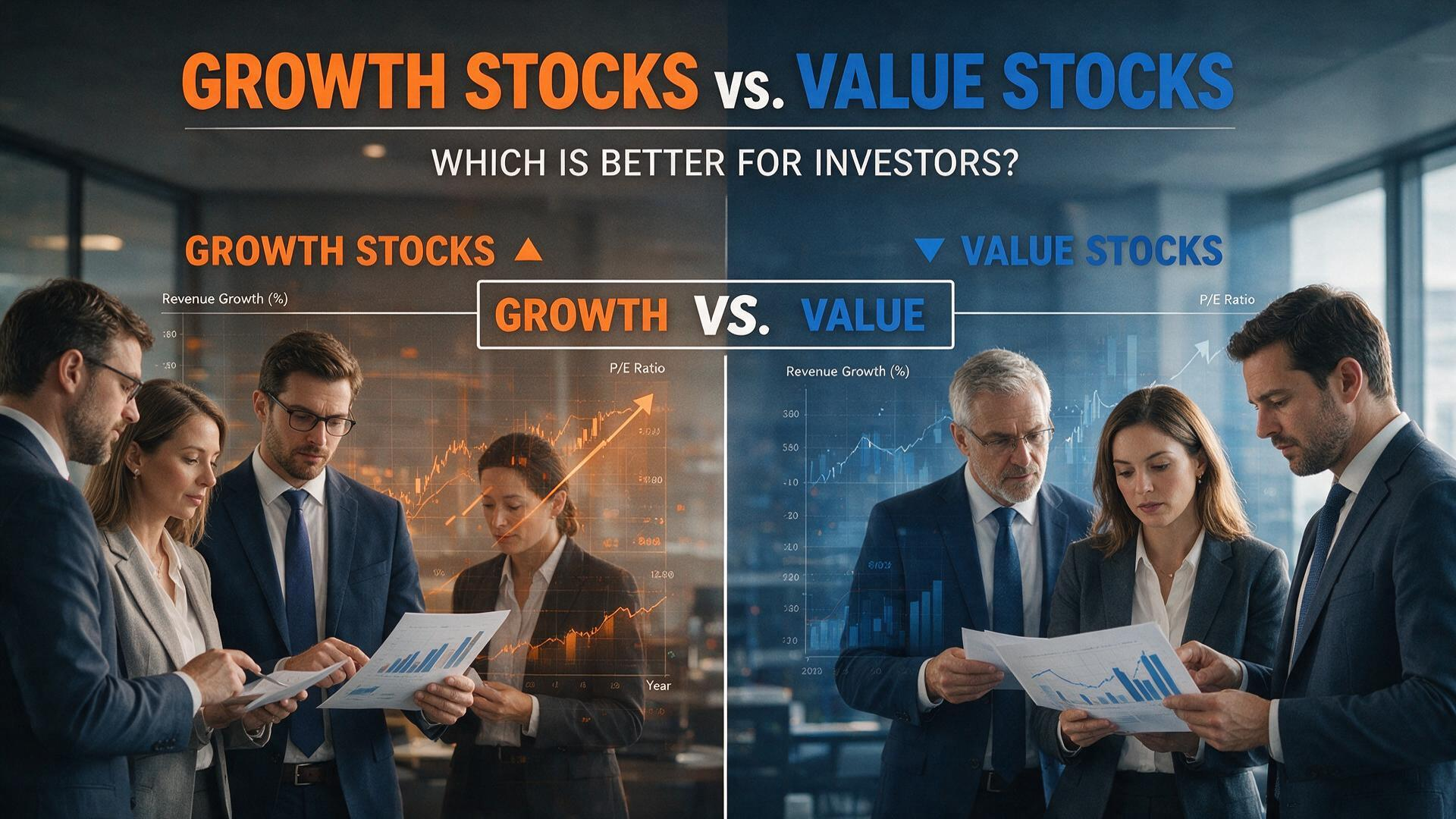
The growth stocks vs value stocks debate tends to get simplified into a stereotype: growth investors chase exciting companies with soaring prices, while value investors hunt for bargains in the discount bin. There's a kernel of truth there, but it misses the nuance. Growth investing is about paying up for businesses that are expanding rapidly, betting that future earnings will justify today's high price. Value investing is about paying less than a business is worth, betting that the market's pessimism has gone too far. Both are trying to make money; they just disagree about where the money comes from. One looks forward, the other looks at the gap between price and fundamentals. Understanding that distinction is the foundation for everything else.
What also gets lost in the argument is that the categories aren't as clean as they sound. A company can be both fast-growing and cheaply valued, and plenty of "growth" stocks have turned into value plays as their expansion slowed. Plenty of "value" stocks have reaccelerated and become growth stories. The labels are useful shorthand, but they're not hard rules, and investors who treat them as gospel sometimes miss opportunities that sit right in the middle. The better approach is to understand the mechanics of each style, recognize when the market is rewarding one over the other, and build a portfolio that reflects your own strengths rather than picking a side out of loyalty.
What Growth Investing Actually Requires
Growth stock investing is built on a simple but demanding premise: find companies that can grow revenue and earnings much faster than the broader market, buy them, and let the compounding of that growth reward you over time. The classic growth company operates in a large and expanding market, has a product or service that customers love, and can reinvest its profits at high rates of return for years. Think of the technology leaders, the healthcare innovators, the disruptors that are taking share from slower-moving incumbents. When these companies deliver, the stock returns can be spectacular, which is why growth investing captures so much attention.
The catch is that growth stocks are priced for perfection. Because investors are buying future earnings rather than current ones, valuations can stretch far beyond what traditional metrics would suggest is reasonable. A growth stock might trade at thirty, forty, or even fifty times earnings, and that leaves little room for disappointment. If the company misses expectations, slows down, or faces unexpected competition, the stock can fall hard and fast. This volatility is the tax you pay for the chance at outsized returns, and it's why growth investing demands a strong stomach and a long time horizon. Investors who panic during drawdowns tend to sell at exactly the wrong moment, locking in losses that a patient holder would have ridden out.
Successful growth investors focus intensely on the quality and durability of the growth. A company growing 30% a year is only valuable if it can keep growing, and that requires a large addressable market, a durable competitive advantage, and a management team that knows how to reinvest capital wisely. The key metric isn't just the growth rate but the return on the capital being reinvested. A business that grows fast but earns poor returns on that growth is burning money, not compounding it. Investors also need to think carefully about valuation, even though growth investing is often framed as valuation-agnostic. Paying a reasonable price for exceptional growth is very different from paying any price at all, and the investors who remember that distinction tend to fare better over full cycles.
Timing is another challenge. Growth stocks tend to run in long cycles, and the periods when they outperform can be dramatic. But those periods are followed by stretches when value dominates, and growth investors who stay fully committed through the lean years can suffer badly. Building a diversified portfolio of growth names, sizing positions carefully, and maintaining realistic expectations about drawdowns are essential survival skills. The point isn't to avoid risk entirely but to understand the specific risks you're taking and make sure they're ones you can live with. Growth investing can build serious wealth, but it rewards discipline and patience as much as it rewards insight.

What Value Investing Demands in Return
Value stock strategies start from a different place. Instead of looking for companies that will grow fastest, value investors look for companies whose shares are trading for less than they're worth. The bet is that the market has overreacted to bad news, or overlooked a business that's quietly solid, and that the price will eventually catch up to the underlying value. It's a contrarian approach by nature, because the best opportunities usually appear in companies that are unpopular, out of favor, or simply boring. Value investors make their money from the gap between price and intrinsic value, not from the pace of growth.
The appeal of value investing is the margin of safety. If you buy a business for meaningfully less than it's worth, you have a cushion if your analysis is slightly wrong or if the market stays irrational longer than expected. That cushion is what allows value investors to sleep at night during downturns, and it's why the approach has historically delivered solid long-term returns with somewhat less drama than growth. Value stocks also tend to pay dividends, which provides income along the way and helps offset the waiting period. For investors who want a steadier ride and a more tangible connection to the cash their companies generate, value has real attractions.
But value investing has its own demanding requirements, and the biggest is patience. Value stocks can stay cheap for years, and the catalyst that finally closes the gap is sometimes slow to arrive. That's the "value trap" risk — a stock that looks cheap because it is cheap, and stays that way because the business is deteriorating. Distinguishing a temporary setback from a permanent decline requires deep fundamental research, a clear understanding of the industry, and a willingness to walk away when the numbers don't support the story. Value investors who skip that work often end up holding a portfolio of cheap-looking stocks that never recover, which is why the discipline of thorough analysis matters so much in this style.
Value investing also demands emotional resilience. Buying what's unpopular means going against the crowd, and the crowd is often loud. Watching a growth stock soar while your cheap holding sits flat takes conviction, and it's easy to second-guess yourself when the market seems to be ignoring your thesis. That's why the best value investors keep detailed notes on why they bought, what they expect, and what would prove them wrong. Reviewing those notes during periods of doubt helps separate a broken thesis from a temporary frustration. The approach works best for investors who can think independently, do their own research, and stay comfortable with being alone in their views for extended periods.
How the Two Styles Perform Across Cycles
One of the most useful things to understand about equity investment strategies is that leadership rotates. Growth and value don't win at the same time, and the periods of dominance can last for years. The late 1990s were a growth investor's dream, followed by a brutal stretch for growth in the early 2000s when value reigned. The 2010s were another long run for growth, and then value came roaring back in the early 2020s. These cycles are not random noise — they're driven by interest rates, inflation, economic conditions, and shifting investor sentiment. Understanding them doesn't let you perfectly time the rotation, but it does help you avoid the mistake of assuming the recent past will continue forever.
Interest rates are one of the biggest drivers. Growth stocks derive most of their value from future earnings, so when rates rise, those future earnings are worth less in today's dollars, and growth valuations tend to compress. Value stocks, by contrast, tend to hold up better in rising-rate environments because their value is tied to current cash flows. Inflation plays a similar role: growth companies often have to wait longer for their profits to materialize, while value companies generate cash now, which can be more attractive when inflation is eating into future purchasing power. None of this is a precise timing tool, but it explains why the two styles trade leadership as the economic backdrop changes.
The practical takeaway is that neither style is permanently superior, and investors who commit fully to one approach are exposed to long periods of underperformance. A more balanced approach is to own a mix of both, either through a blended portfolio or by allocating across styles. That way, you're not betting everything on one set of conditions persisting. Some investors do this by owning broad index funds that include both, while others deliberately tilt toward one style while keeping some exposure to the other. The key is to be intentional about it rather than drifting into a lopsided portfolio simply because one side has been winning lately. Chasing recent performance is one of the most reliable ways to underperform, and style rotation is one of the most common places investors get caught.
It's also worth paying attention to valuation spreads between the two styles. When growth is trading at an enormous premium to value, the risks on the growth side are higher, and the opportunities on the value side may be better. When the spread is narrow, the reverse tends to be true. Tracking this doesn't require complicated tools — a simple look at relative valuations between growth and value indexes can give you a sense of where the market is leaning. Being aware of these dynamics helps you avoid the trap of piling into whatever has been working and ignoring the risks that come with it.
Choosing the Approach That Fits You
The honest answer to "which is better" is that it depends on the investor. Both styles can build wealth, and both can destroy it if pursued without discipline. The right choice depends on your temperament, your time horizon, and how much volatility you can tolerate. Growth investing tends to suit people who can handle big swings, who are comfortable with uncertainty, and who have a long enough horizon to ride out drawdowns. Value investing tends to suit people who are patient, enjoy digging into financials, and take comfort in owning something at a discount. Neither preference is better or worse, but mismatching your style to your personality is a reliable recipe for bad decisions.
Time horizon matters a great deal. Growth stocks need time to let their earnings catch up to their valuations, and the compounding happens over years and decades. Selling after a few months rarely captures the intended benefit. Value stocks also need time for the discount to close, but the payoff can come sooner if a catalyst appears. Younger investors with long careers ahead can afford to lean more heavily into growth, since they have time to recover from mistakes and fresh capital to deploy along the way. Investors nearing retirement often find value's steadier profile and dividend income more suitable for their needs. The point isn't to pick a side forever but to match the style to the stage of life and financial situation.
A hybrid approach deserves serious consideration for many investors. Combining growth and value exposure lets you participate in the upside of fast-growing companies while maintaining the cushion and income of discounted ones. It also smooths your returns across cycles, since one style often holds up when the other struggles. Some investors run a core-satellite portfolio, with a broad market index as the core and smaller allocations to growth and value as satellites. Others blend individual stocks from both categories, sizing positions so that no single style dominates. The common thread is diversification across styles, which reduces the risk of being wrong about which one will lead over the next few years.
Whatever you choose, remember that the growth vs value debate is ultimately a question about the future, and nobody knows the future with certainty. The investors who do best are usually the ones who stay disciplined, keep costs low, avoid chasing performance, and stick to a process they understand. Whether that process leans growth, value, or a blend of both, the habits that make it work are the same: do the research, control your emotions, size your positions sensibly, and let time do its job. Pick the approach that fits you, commit to it with eyes open, and stay humble enough to adjust when the facts change.